CALQUENCE 100 MG — DIN 02535696
ACALABRUTINIB (ACALABRUTINIB MALEATE) : 100 MG · ASTRAZENECA CANADA INC · TABLET · wholesale supply in Canada
Health Canada status: MARKETED
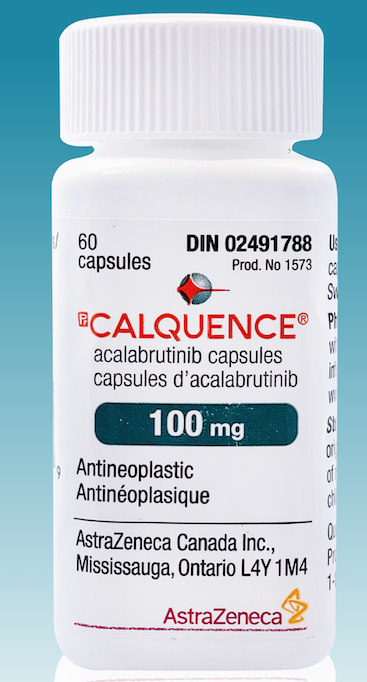
What is CALQUENCE?
CALQUENCE 100 MG contains ACALABRUTINIB (ACALABRUTINIB MALEATE) : 100 MG. It is listed in the Health Canada Drug Product Database under DIN 02535696, held by ASTRAZENECA CANADA INC, supplied as TABLET for ORAL administration. Health Canada currently lists it as marketed, status dated 01-May-2023. Nexara Health is a licensed Canadian wholesale distributor (DEL 3-002896-A) and can source this product for hospitals, pharmacies and clinics. Availability and lead time are confirmed per order.
What is CALQUENCE used for?
CALQUENCE® (acalabrutinib tablets) is indicated for: Chronic Lymphocytic Leukemia (CLL): - In combination with venetoclax for the treatment of patients with previously untreated CLL. - In combination with obinutuzumab or as monotherapy for the treatment of patients with previously untreated CLL. - As monotherapy for the treatment of patients with CLL who have received at least one prior therapy. Mantle Cell Lymphoma (MCL): - In combination with bendamustine and rituximab for the treatment of adult patients with previously untreated MCL who are ineligible for autologous stem cell transplant. - As monotherapy for the treatment of patients with MCL who have received at least one prior therapy.
Authorized indication as written in the Health Canada product monograph. For healthcare professionals and licensed purchasers; this is not medical advice.
How much does Acalabrutinib cost around the world?
Acalabrutinib is listed on 13 of the national price registers Nexara ingests. Each country publishes on a different basis, so those figures are not comparable with one another — or with a Canadian wholesale price.
What a market publishes matters more than the number it publishes. Australia publishes a ex-manufacturer; Austria publishes a KVP (Kassenverkaufspreis); Bahrain publishes a retail (max). Comparing an ex-factory ceiling against a pharmacy public price tells you nothing about either, and comparing either against a Canadian landed cost tells you less.
| Market | Price basis published there | Brands | Packs listed | Range |
|---|---|---|---|---|
| Australia | ex-manufacturer | 1 | 7 | AUD███.██ |
| Saudi Arabia | public | 2 | 3 | SAR███.██ |
| Bahrain | retail (max) | 1 | 2 | BHD███.██ |
| Italy | ex-factory (classe H) | 2 | 2 | EUR███.██ |
| United Arab Emirates | public | 1 | 1 | AED███.██ |
| Austria | KVP (Kassenverkaufspreis) | 1 | 1 | EUR███.██ |
| Czechia | max producer price (ex-factory) | 1 | 1 | CZK███.██ |
| Greece | producer price (ex-factory) | 1 | 1 | EUR███.██ |
| Hungary | producer price (ex-factory) | 1 | 1 | HUF███.██ |
| Iceland | max wholesale | 1 | 1 | ISK███.██ |
| Luxembourg | reimbursement | 1 | 1 | EUR███.██ |
| Romania | max producer price | 1 | 1 | RON███.██ |
| South Africa | single exit price | 1 | 1 | ZAR███.██ |
23 pack listings across 15 brand entries and 11 price bases, refreshed 08 Sep 2026. Ranges span every Acalabrutinib pack in that market, so a high figure is usually a larger pack rather than the same product.
Canada publishes no comparable public list price. For a delivered Canadian price on a licensed account, verify your licence — it takes about a minute.
Is there a generic Acalabrutinib in Canada, and who makes it?
Every market authorization holder with a Canadian DIN for this molecule, and how many of their listings Health Canada currently shows as marketed.
Only one market authorization holder has a Canadian DIN containing Acalabrutinib — 2 DINs, of which 1 are currently marketed. There is no second Canadian source today, so a supply interruption on this holder has no domestic substitute at the same molecule.
| Market authorization holder | DINs | Marketed | Brand names | Position |
|---|---|---|---|---|
| ASTRAZENECA CANADA INC | 2 | 1 | CALQUENCE | Sourceable in Canada |
Health Canada’s Drug Product Database does not flag which listing is the originator and which are subsequent-entry products, so Nexara does not label them here. Interchangeability is determined provincially, not federally — confirm for your province before a formulary switch. Nexara can confirm which of these is actually obtainable, and on what lead time, per order.
How is it supplied and stored?
Pack configuration, storage class and the handling constraints that drive cold-chain planning. One DIN can cover more than one pack size, and the pack — not the DIN — is what gets priced, shipped and invoiced.
| Strength on the label | 100 MG |
|---|---|
| Dosage form | TABLET |
| Route | ORAL |
| Pack configuration (monograph) | CALQUENCE 100 mg tablets are provided in white high-density polyethylene (HDPE) plastic bottles, containing desiccant, with a child-resistant closure containing 60 tablets. CALQUENCE (acalabrutinib tablets) is also available as 100 mg acalabrutinib capsules. Do not substitute CALQUENCE tablets with CALQUENCE capsules without prior consideration of the CALQUENCE capsules Product Monograph, Dosage and Administration section regarding drug interactions with gastric acid reducing agents. |
| Storage | Store CALQUENCE at room temperature, between 15°C-30°C, in original bottle. Keep out of reach and sight of children. |
Before an order line is unambiguous Nexara needs the strength, the pack size and the presentation.
Substance and classification
| Active substance | Acalabrutinib |
|---|---|
| ATC code | L01EL02 |
| Biosimilar biologic | No |
Health Canada record and identifiers
The regulatory facts straight from the Drug Product Database, plus every identifier form Nexara accepts on a purchase order. A DIN written without its leading zeros is the commonest reason an order line fails to match.
| DIN (8-digit, as used in ordering) | 02535696 |
|---|---|
| DIN (unpadded, as printed on some documents) | 2535696 |
| Brand name | CALQUENCE |
| Generic / active ingredient | ACALABRUTINIB (ACALABRUTINIB MALEATE) : 100 MG |
| Market authorization holder | ASTRAZENECA CANADA INC |
| Health Canada schedule | Prescription |
| ATC code | L01EL02 |
| ATC anatomical main group | L — Antineoplastic and immunomodulating agents |
| ATC therapeutic subgroup | L01EL |
| Current status | MARKETED |
| Status date | 01-May-2023 |
| Status source | Live Health Canada DPD sync |
Verify on the primary sources
How is it administered?
The recommended dose of CALQUENCE for patients with CLL or MCL is 100 mg (1 tablet) twice daily, separated by approximately 12 hours. CALQUENCE should be swallowed whole with water at approximately the same time each day, with or without food. The tablet should not be chewed, crushed, dissolved, or divided. For CLL: - In combination with venetoclax: Start CALQUENCE at cycle 1 (each cycle is 28 days) for 14 cycles. Start venetoclax at cycle 3 as per the dose titration schedule (20 mg Week 1, 50 mg Week 2, 100 mg Week 3, 200 mg Week 4, 400 mg Cycle 4 Week 1 and subsequent dosing up to and including Cycle 14). Administer venetoclax for a total of 12 cycles. - In combination with obinutuzumab or as monotherapy: Treatment with CALQUENCE should continue until disease progression or unacceptable toxicity. Start CALQUENCE at cycle 1 (each cycle is 28 days). Start obinutuzumab at cycle 2 for a total of 6 cycles. - For patients with CLL who have received at least one prior therapy: CALQUENCE is used as monotherapy until disease progression or unacceptable toxicity. For MCL: - In combination with bendamustine and rituximab: Start CALQUENCE at cycle 1 (each cycle is 28 days). Start bendamustine and rituximab at cycle 1 for 6 cycles. Bendamustine (90mg/m²) on Days 1 and 2. Rituximab (375 mg/m²) on Day 1. For patients achieving a response, rituximab continues for a maximum of additional 12 doses every other cycle. Treatment with CALQUENCE should continue until disease progression or unacceptable toxicity. - For patients with MCL who have received at least one prior therapy: CALQUENCE is used as monotherapy until disease progression or unacceptable toxicity. Missed Dose: If a patient misses a dose by more than 3 hours, instruct the patient to take the next dose at its regularly scheduled time. Extra tablets should not be taken to make up for a missed dose. Dose Adjustments for Adverse Reactions: Refer to Tables 2, 3, and 4 in the monograph for specific dose modifications based on adverse reaction grade and occurrence. For strong CYP3A inhibitors, avoid concomitant use or interrupt CALQUENCE for short-term use. For moderate CYP3A inhibitors, reduce CALQUENCE to 100 mg once daily. No dose adjustment for mild CYP3A inhibitors. No dose adjustment for mild to moderate renal impairment or mild to moderate hepatic impairment. Avoid in severe hepatic impairment (Child-Pugh C or total bilirubin >3 times ULN).
Included because it drives pack selection and wastage. Consult the monograph.
Contraindications
CALQUENCE (acalabrutinib) is contraindicated in patients who are hypersensitive to acalabrutinib or to any ingredient in the formulation, including any non-medicinal ingredient, or component of the container.
Warnings and precautions
Serious Warnings and Precautions Box: - Treatment with CALQUENCE should be initiated and supervised by a qualified physician experienced in the use of anticancer therapies. - Concomitant use of CALQUENCE with a strong CYP3A inhibitor should be avoided. - Serious Hemorrhage: Monitor for bleeding and manage appropriately. Carcinogenesis and Genotoxicity: Second primary malignancies, including skin and other solid tumours, have been reported more frequently. Monitor patients for the development of second cancers and advise protection from the sun. Cardiovascular: Atrial Fibrillation or atrial flutter reported in 6% of patients (Grade 3 or 4 in 2.1%). Risk may be increased in patients with pre-existing cardiovascular disease, hypertension, previous history of atrial fibrillation, and infection/pneumonia. Monitor for symptoms of cardiac arrhythmia. Driving and Operating Machinery: Fatigue and dizziness have been reported. Patients experiencing these symptoms should observe caution when driving or operating a vehicle or potentially dangerous machinery. Hematologic: Cytopenias (Grade 3 or higher absolute neutrophil count decreased (35%), absolute lymphocyte count decreased (22%), platelets decreased (11%) and hemoglobin decreased (9%)) occurred. Monitor complete blood counts regularly. Interrupt treatment, reduce the dose, or discontinue treatment as necessary. Hemorrhage: Serious hemorrhagic events, including fatal events, reported in 4.5% of patients. Overall bleeding events (including bruising and petechiae) occurred in 40%. Patients receiving antithrombotic agents concomitantly may be at increased risk. Consider risks and benefits of antithrombotic agents. Consider withholding CALQUENCE for at least 3 days pre- and post-surgery. Hepatic: Hepatotoxicity, including severe, life-threatening, and potentially fatal cases of drug-induced liver injury (DILI), has occurred. Evaluate bilirubin and transaminases at baseline and throughout treatment. Monitor for liver test abnormalities and clinical signs/symptoms of hepatic toxicity. Withhold CALQUENCE if DILI suspected; discontinue upon confirmation. Immune (Infections): Serious and fatal infections (bacterial, viral or fungal) have occurred. Most frequently reported Grade 3 or higher infection was pneumonia. Monitor patients for signs and symptoms of infection and treat promptly. Opportunistic infections (PML, hepatitis B virus reactivation, herpes zoster, aspergillosis, fungal pneumonia, Pneumocystis Jiroveci Pneumonia) have been reported. Consider prophylaxis in patients at increased risk for opportunistic infections.
What can be used instead?
Alternatives on every axis a buyer actually considers — the same molecule in another presentation, the same class, an adjacent class, or a fixed-dose combination. Every row is led by the marketed DIN count, because that is what can be bought this week.
1 · Same molecule, other Canadian presentations
1 of 2 Canadian DINs for this molecule are currently marketed. Marketed products are listed first.
| Product | Strength | Form | Holder | Health Canada status | DIN |
|---|---|---|---|---|---|
| CALQUENCE | 100 MG | CAPSULE | ASTRAZENECA CANADA INC | DORMANT | 02491788 |
2 · Same class — other molecules in ATC L01EL
| Molecule | Canadian brands | DINs | Marketed | Sourceable |
|---|---|---|---|---|
| Ibrutinib | IMBRUVICA | 6 | 2 | Yes |
| Zanubrutinib | BRUKINSA | 2 | 2 | Yes |
| Acalabrutinib | CALQUENCE | 2 | 1 | Yes |
A molecule with zero marketed DINs cannot be sourced domestically, however many approvals it holds — if one of these sits on a formulary or in an older protocol, that is the line to check.
3 · Adjacent classes in ATC L01E
| ATC subgroup | Molecules | DINs | Marketed |
|---|---|---|---|
| L01EX | Avapritinib · Cabozantinib · Capivasertib · Capmatinib · Entrectinib · +17 more | 80 | 64 |
| L01EA | Asciminib · Bosutinib · Dasatinib · Imatinib · Nilotinib · +1 more | 73 | 57 |
| L01EB | Afatinib · Dacomitinib · Erlotinib · Gefitinib · Lazertinib · +1 more | 40 | 23 |
| L01EF | Abemaciclib · Palbociclib · Ribociclib | 17 | 14 |
| L01ED | Alectinib · Brigatinib · Ceritinib · Crizotinib · Lorlatinib | 10 | 10 |
| L01EJ | Fedratinib · Momelotinib · Ruxolitinib | 8 | 8 |
| L01EE | Binimetinib · Cobimetinib · Selumetinib · Trametinib | 8 | 7 |
| L01EN | Erdafitinib · Infigratinib · Pemigatinib | 11 | 6 |
Not clinical advice. These tables describe what can be supplied in Canada, not what should be prescribed. Substitution within or across classes is a prescriber and pharmacist decision, and interchangeability is determined provincially.
What else is CALQUENCE called?
Also recorded in Canada as: ACALABRUTINIB (GLOBAL), ACALABRUTINIB (US), ACALABRUTINIB (UK).
The same molecule, Acalabrutinib, is registered under other names elsewhere. Buyers and prescribers searching from outside Canada — or working from a foreign prescription or tender document — often know it by one of these:
| Name | Script | Registered in |
|---|---|---|
| Acalabrutinib BOS | Latin | Saudi Arabia |
Names are taken from national medicine registers and published price lists. A product registered abroad is not authorized for sale in Canada unless it holds its own DIN; import is possible only through the routes Health Canada permits.
How can I get it?
Nexara Health supplies this product to licensed Canadian buyers — pharmacies, hospitals, clinics, licensed distributors, and clinical trial sponsors or their CROs. We confirm stock, pack size, expiry and pricing at the time of quotation. If the product is on backorder or in shortage, we identify equivalent alternatives and import options where permitted.
Ordering questions
Who can buy this from Nexara?
Licensed entities only. Nexara holds Health Canada establishment licence DEL 3-002896-A and ships only to a licensed address. Patients and unlicensed buyers are routed to a partner pharmacy.
Is there a minimum order?
Yes, set per product line and per pack multiple rather than on the order total, so you are never asked to buy a part-pack. The minimum for this line is confirmed with your quote.
What is the lead time?
Confirmed per order at quotation, and it depends on current stock position and whether the product is in shortage.
Why is there no price on this page?
Nexara quotes a delivered Canadian price per order, against a verified licence. Foreign list prices are published on incompatible bases and are not a guide to what any buyer can obtain here, so this page shows which markets list the molecule and on what basis, and nothing more.
Can Nexara supply this for a clinical trial?
Yes — comparator and background-therapy supply, including sourcing from other markets where a Canadian pack will not satisfy the protocol. Clinical trial supply.