RUZURGI 10 MG
AMIFAMPRIDINE : 10 MG · DIN 02503034 · MEDUNIK CANADA
Health Canada status: MARKETED
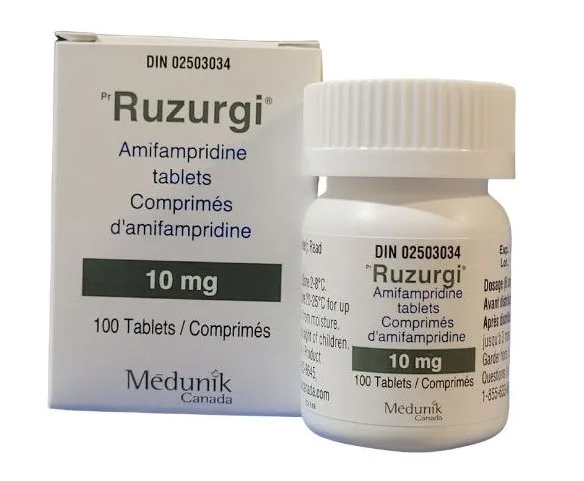
What is RUZURGI?
RUZURGI 10 MG contains AMIFAMPRIDINE : 10 MG. It is listed in the Health Canada Drug Product Database under DIN 02503034, held by MEDUNIK CANADA, supplied as TABLET for ORAL administration. Health Canada currently lists it as marketed, status dated 24-Jan-2023. Nexara Health is a licensed Canadian wholesale distributor (DEL 3-002896-A) and can source this product for hospitals, pharmacies and clinics. Availability and lead time are confirmed per order.
What is RUZURGI used for?
RUZURGI (amifampridine) is indicated for the symptomatic treatment of Lambert-Eaton myasthenic syndrome (LEMS) in patients 6 years of age and older. Lambert-Eaton myasthenic syndrome (LEMS) should be diagnosed by a health professional who has experience and knowledge in clinical features of this disease. RUZURGI should only be prescribed by health professionals who have experience in the treatment of LEMS, are knowledgeable of the efficacy and safety profile of this drug, and are able to discuss benefits/risks of treatment with patients.
Authorized indication as written in the Health Canada product monograph. For healthcare professionals and licensed purchasers; this is not medical advice.
Product details and regulatory record
| DIN | 02503034 |
|---|---|
| Brand name | RUZURGI |
| Generic / active ingredient | AMIFAMPRIDINE : 10 MG |
| Manufacturer | MEDUNIK CANADA |
| Strength | 10 MG |
| Dosage form | TABLET |
| Route of administration | ORAL |
| Schedule | Prescription |
| ATC code | N07XX05 AMIFAMPRIDINE |
| AHFS class | 38:00.00 |
| Biosimilar | No |
| Health Canada status | MARKETED |
| Status date | 24-Jan-2023 |
| Original market date | 2020-09-18 00:00:00 |
How is it administered?
Dosing should be individualized based on disease severity, patient response, and patient population. RUZURGI should be initiated at the lowest possible dose and titrated slowly to effect while closely monitoring tolerability and adverse events. The recommended oral dose is based on body weight. For patients weighing less than 45 kg: Initial Dose 5 mg to 10 mg daily, in divided doses (2 to 3 times per day). Titration Regimen: Increase daily in 2.5 mg to 5 mg increments, divided in up to 5 doses per day. Maximum Recommended Single Dose: 10 mg. Maximum Total Daily Maintenance Dose: 40 mg. For patients weighing 45 kg or more: Initial Dose 10 mg to 20 mg daily, in divided doses (2 to 3 times per day). Titration Regimen: Increase daily in 5 mg to 10 mg increments, divided in up to 5 doses per day. Maximum Recommended Single Dose: 20 mg. Maximum Total Daily Maintenance Dose: 80 mg (some patients may benefit from a total daily dose of 100 mg). Known N-acetyltransferase 2 (NAT2) Slow Acetylators: For patients weighing less than 45 kg, initial dose is 5 mg daily in divided doses (2 to 3 times per day). For patients weighing 45 kg or more, initial dose is 10 mg daily in divided doses (2 to 3 times per day). Use in Hepatic Impairment: Initiate cautiously with lowest recommended initial single and total daily doses. For mild and moderate hepatic impairment: <45 kg, 5 mg daily (2-3 times/day), max 20 mg/day; ≥45 kg, 10 mg daily (2-3 times/day), max 40 mg/day. No recommendations for severe hepatic impairment. Use in Renal Impairment: Titrate more slowly, using the lowest dose. For <45 kg, 7.5 mg daily in divided doses, max 20 mg/day. For ≥45 kg (creatinine clearance 15 to 90 mL/min), 15 mg daily in divided doses, max 40 mg/day. No recommendations for end-stage renal disease or dialysis. Administration: Can be taken without regard to food intake; food may mitigate paresthesia and abdominal discomfort. For dosages less than 5 mg increments, difficulty swallowing, or feeding tubes, a 1 mg/mL suspension can be prepared by placing three 10 mg tablets in a 30 mL container, adding 30 mL sterile water, and shaking well for 30 seconds. The suspension should be refrigerated between doses and shaken well before drawing up each dose. Store suspension under refrigeration for up to 24 hours; discard unused portion after 24 hours. Missed Dose: If missed by a few hours and weakness is experienced, take usual dose as soon as possible. If close to next dose, take at next regular interval. Do not take double or extra doses.
Included because it drives pack selection and wastage. Consult the monograph.
How is it stored and handled?
Bottle (tablets): Prior to Dispensing: Store under refrigeration (2°C to 8°C). Keep container tightly closed with desiccant canister inside after opening. Protect from moisture and light. After Dispensing: Store at room temperature (20 to 25°C) for up to 3 months. Protect from moisture. Keep out of reach and sight of children. 1mg/mL Suspension: The suspension can be stored under refrigeration (2°C to 8°C) for up to 24 hours. Discard any unused portion of the suspension after 24 hours.
How is it supplied?
RUZURGI tablets are oval, white to off-white, scored and debossed on one side with the numbers "10" to the left of the score mark and "110" to the right of the score mark, or "10 | 110", and debossed with "JACOBUS" on the other side. The 10 mg tablets are functionally scored to facilitate splitting. RUZURGI is supplied in HDPE bottles of 100 tablets with desiccant and a child-resistant polypropylene screw cap.
Contraindications
RUZURGI (amifampridine) is contraindicated in patients who: * Are hypersensitive to this drug or to any ingredient in its formulation, including any non-medicinal ingredient, or component of the container. * Have history of seizures. * Are taking other forms of amifampridine or other aminopyridines.
Warnings and precautions
QTc Interval Prolongation: RUZURGI can cause QTc interval prolongation, particularly in N-acetyltransferase 2 slow acetylators, increasing the risk of torsade de pointes, a polymorphic ventricular tachyarrhythmia. Torsade de pointes can be asymptomatic or present as dizziness, palpitations, syncope, or seizures, potentially progressing to ventricular fibrillation and sudden cardiac death. Caution is advised in patients with risk factors for torsade de pointes, including female gender, age ≥65 years, baseline QTc prolongation, congenital long QT syndrome, cardiac disease (e.g., myocardial infarction, heart failure), history of arrhythmias, bradycardia (<50 beats per minute), and electrolyte disorders. Hypokalemia, hypocalcemia, and hypomagnesemia should be corrected prior to initiation or continuation of RUZURGI. Endocrine and Metabolism: Exposure to RUZURGI is increased in N-acetyltransferase (NAT2) slow acetylators. Initiate RUZURGI at the lowest recommended starting dose and monitor for adverse reactions. Dose titration should be based on clinical response and tolerability. Hepatic/Biliary/Pancreatic: RUZURGI is extensively metabolized/acetylated by NAT2. Hepatic impairment can increase exposure. Initiate RUZURGI in patients with mild and moderate hepatic impairment using the lowest recommended initial single and total daily doses. Additional caution and monitoring of adverse reactions are recommended for patients with severe hepatic impairment. Neurologic (Seizures): RUZURGI can cause seizures, observed in patients with and without previous history of seizures at recommended therapeutic doses. Seizures may be dose-dependent. RUZURGI is contraindicated in patients with a history of seizures and should be used with caution in combination with drugs known to lower seizure threshold. Renal: Renal clearance is an elimination pathway for RUZURGI and its inactive metabolite. In patients with mild or moderate renal impairment, initiate RUZURGI at the lowest recommended starting dosage and monitor closely for adverse reactions. In patients with severe renal impairment, extra caution should be exercised, and patients should be monitored for tolerability and adverse reactions. Consider dose reduction or discontinuation as needed. Sensitivity/Resistance: Hypersensitivity reactions and anaphylaxis have not been reported in clinical trials with RUZURGI, but can occur as reported with other aminopyridines. If anaphylaxis occurs, discontinue RUZURGI and initiate appropriate therapy.
What can be used instead?
Other Canadian products sharing ATC code N07XX05 AMIFAMPRIDINE. 2 of 2 DINs in this group are currently marketed — marketed products are listed first, because that is what can actually be bought. These tables describe supply, not clinical equivalence: substitution rests with the prescriber or pharmacist, and interchangeability is determined provincially.
| Product | Strength | Form | Manufacturer | Health Canada status | DIN |
|---|---|---|---|---|---|
| FIRDAPSE | 10 MG | TABLET | KYE PHARMACEUTICALS INC. | MARKETED | DIN 02502984 |
Who else supplies AMIFAMPRIDINE worldwide?
Nexara tracks national medicine registries and published price lists across multiple markets. AMIFAMPRIDINE appears in 3 registered pack listings across 3 markets, published on 3 different national price bases. Where a Canadian route is closed, that is where an alternative route of supply starts — subject to the import rules in both countries.
Registered listings are not stock. Ask us to confirm what can actually be sourced for your order.
How can I get it?
Nexara Health supplies this product to licensed Canadian buyers — pharmacies, hospitals, clinics, licensed distributors, and clinical trial sponsors or their CROs. We confirm stock, pack size, expiry and pricing at the time of quotation. If the product is on backorder or in shortage, we identify equivalent alternatives and import options where permitted.
Ordering questions
Who can buy this from Nexara?
Licensed entities only. Nexara holds Health Canada establishment licence DEL 3-002896-A and ships only to a licensed address.
Is there a minimum order?
Yes, set per product line and per pack multiple rather than on the order total, so you are never asked to buy a part-pack. The minimum for this line is confirmed with your quote.
What is the lead time?
Confirmed per order at quotation, and it depends on current stock position and whether the product is in shortage.
Can Nexara supply this for a clinical trial?
Yes — comparator and background-therapy supply, including sourcing from other markets where a Canadian pack will not satisfy the protocol. Clinical trial supply.