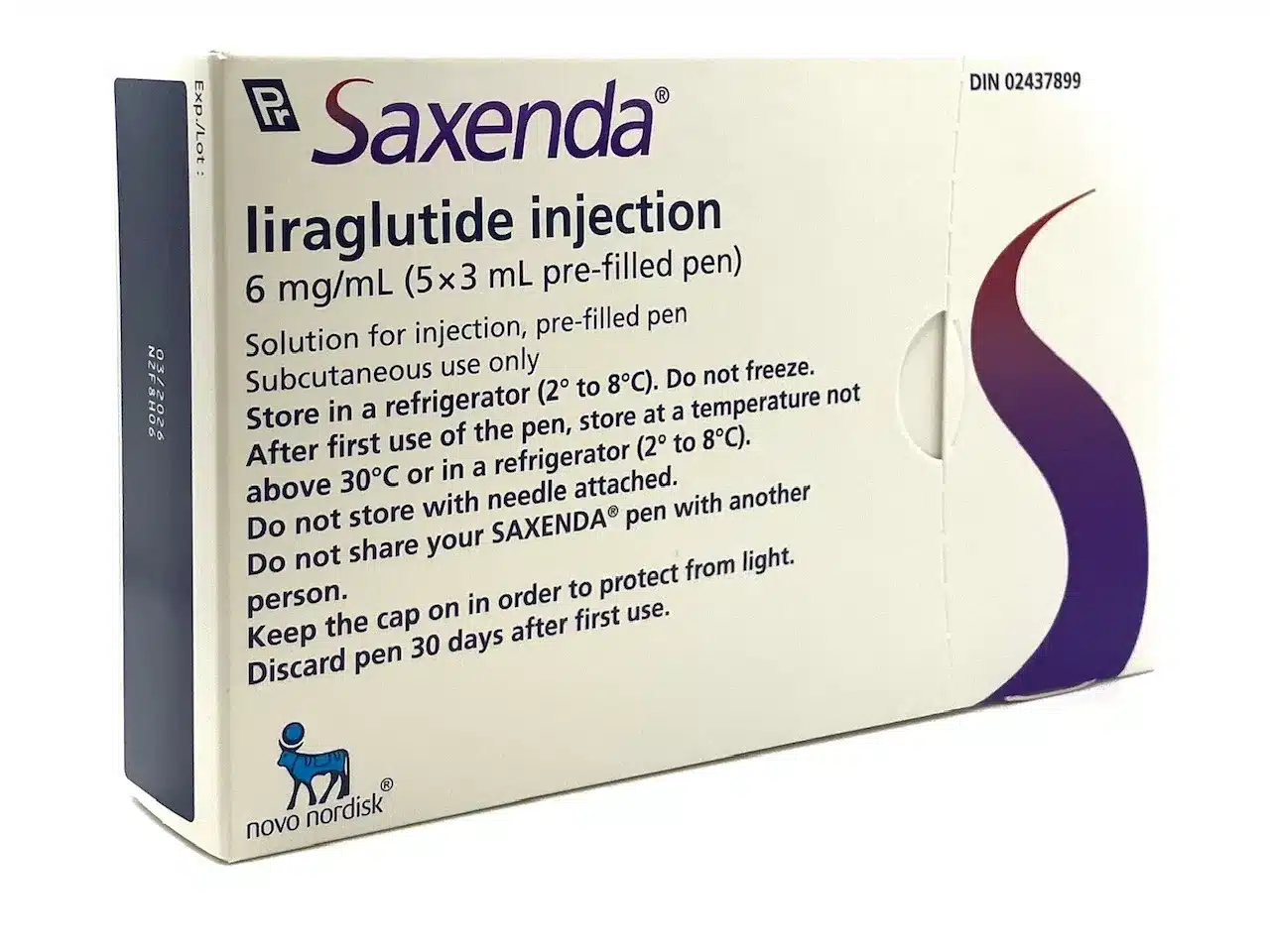
SAXENDA 6 MG — DIN 02437899
LIRAGLUTIDE : 6 MG · NOVO NORDISK CANADA INC · SOLUTION · wholesale supply in Canada
Health Canada status: MARKETED
What is SAXENDA?
SAXENDA 6 MG contains LIRAGLUTIDE : 6 MG. It is listed in the Health Canada Drug Product Database under DIN 02437899, held by NOVO NORDISK CANADA INC, supplied as SOLUTION for SUBCUTANEOUS administration. Health Canada currently lists it as marketed, status dated 27-May-2015. Nexara Health is a licensed Canadian wholesale distributor (DEL 3-002896-A) and can source this product for hospitals, pharmacies and clinics. Availability and lead time are confirmed per order.
What is SAXENDA used for?
SAXENDA® (liraglutide injection) is indicated as an adjunct to a reduced calorie diet and increased physical activity for chronic weight management in adult patients with an initial body mass index (BMI) of: • 30 kg/m² or greater (obesity), or • 27 kg/m² or greater (overweight) in the presence of at least one weight-related comorbidity (e.g., hypertension, type 2 diabetes, or dyslipidemia) and who have failed a previous weight management intervention. SAXENDA® is indicated as an adjunct to a reduced calorie diet and increased physical activity for chronic weight management in pediatric patients aged 12 to less than 18 years with: • an inadequate response to reduced calorie diet and increased physical activity alone, and • a body weight above 60 kg (132 lbs), and • an initial body mass index (BMI) corresponding to ≥30 kg/m² for adults (obesity) by international cut-offs* (see Table 1). The safety and efficacy of SAXENDA® in pediatric patients aged 12 to less than 18 Years has been established; therefore, Health Canada has authorized an indication for pediatric use in pediatric patients aged 12 to less than 18 years. The safety and efficacy of SAXENDA® in children and adolescents below 18 years of age with secondary causes of obesity has not been studied.
Authorized indication as written in the Health Canada product monograph. For healthcare professionals and licensed purchasers; this is not medical advice.
How much does Liraglutide cost around the world?
Liraglutide is listed on 10 of the national price registers Nexara ingests. Each country publishes on a different basis, so those figures are not comparable with one another — or with a Canadian wholesale price.
What a market publishes matters more than the number it publishes. Bahrain publishes a retail (max); Greece publishes a producer price (ex-factory); Iceland publishes a max wholesale. Comparing an ex-factory ceiling against a pharmacy public price tells you nothing about either, and comparing either against a Canadian landed cost tells you less.
| Market | Price basis published there | Brands | Packs listed | Range |
|---|---|---|---|---|
| United States | acquisition | 3 | 17 | USD███.██ |
| South Africa | single exit price | 3 | 6 | ZAR███.██ |
| Saudi Arabia | public | 5 | 5 | SAR███.██ |
| United Kingdom | hospital | 4 | 4 | GBP███.██ |
| Greece | producer price (ex-factory) | 3 | 3 | EUR███.██ |
| Bahrain | retail (max) | 2 | 2 | BHD███.██ |
| United Arab Emirates | public | 1 | 1 | AED███.██ |
| Iceland | max wholesale | 1 | 1 | ISK███.██ |
| Italy | prezzo al pubblico (classe A) | 1 | 1 | EUR███.██ |
| Luxembourg | reimbursement | 1 | 1 | EUR███.██ |
41 pack listings across 24 brand entries and 9 price bases, refreshed 05 Sep 2026. Ranges span every Liraglutide pack in that market, so a high figure is usually a larger pack rather than the same product.
Canada publishes no comparable public list price. For a delivered Canadian price on a licensed account, verify your licence — it takes about a minute.
Is there a generic Liraglutide in Canada, and who makes it?
Every market authorization holder with a Canadian DIN for this molecule, and how many of their listings Health Canada currently shows as marketed.
Only one market authorization holder has a Canadian DIN containing Liraglutide — 2 DINs, of which 2 are currently marketed. There is no second Canadian source today, so a supply interruption on this holder has no domestic substitute at the same molecule.
| Market authorization holder | DINs | Marketed | Brand names | Position |
|---|---|---|---|---|
| NOVO NORDISK CANADA INC | 2 | 2 | SAXENDA, VICTOZA | Sourceable in Canada |
Health Canada’s Drug Product Database does not flag which listing is the originator and which are subsequent-entry products, so Nexara does not label them here. Interchangeability is determined provincially, not federally — confirm for your province before a formulary switch. Nexara can confirm which of these is actually obtainable, and on what lead time, per order.
How is it supplied and stored?
Pack configuration, storage class and the handling constraints that drive cold-chain planning. One DIN can cover more than one pack size, and the pack — not the DIN — is what gets priced, shipped and invoiced.
| Strength on the label | 6 MG |
|---|---|
| Dosage form | SOLUTION |
| Route | SUBCUTANEOUS |
| Pack configuration (monograph) | SAXENDA® is a clear, colourless solution for subcutaneous injection pre-filled, multi-dose pen that delivers doses of 0.6 mg, 1.2 mg, 1.8 mg, 2.4 mg, or 3.0 mg (6 mg/mL, 3 mL). SAXENDA® is available in the following package sizes containing disposable, pre-filled, multi-dose pens: 3 x SAXENDA® 5 x SAXENDA® Each pre-filled pen contains a 3 mL solution of SAXENDA® equivalent to 18 mg liraglutide (free-base, anhydrous). |
| Storage | SAXENDA® should be stored in a refrigerator (2°C to 8°C). Do not store in the freezer or directly adjacent to the refrigerator cooling element. Do not freeze SAXENDA® and do not use SAXENDA® if it has been frozen. After initial use of the SAXENDA® pen, the product can be stored for 30 days at room temperature (not above 30°C) or in a refrigerator (2°C to 8°C). SAXENDA® should be kept with the pen cap on when pen is not in use in order to protect from light. SAXENDA® should be protected from excessive heat and sunlight. Always remove the injection needle after each injection and store the SAXENDA® pen without an injection needle attached. This prevents contamination, infection, and leakage. It also ensures that the dosing is accurate. Do not leave the pen in a car or other place where it can get too hot or too cold. Do not expose your pen to dust, dirt or liquid. Do not wash, soak or lubricate your pen. If necessary, clean it with a mild detergent on a moistened cloth. Do not drop your pen or knock it against hard surfaces. If you drop it or suspect a problem, attach a new needle and check the SAXENDA® flow before you inject. Do not try to refill your pen. Once empty, it must be disposed of. Do not try to repair your pen or pull it apart. |
| Shipping class | Cold chain — validated shipper with temperature monitoring |
Before an order line is unambiguous Nexara needs the strength, the pack size and the presentation, because this listing covers more than one of them.
Cold chain. This product is stored refrigerated. Nexara ships it on a validated cold chain with temperature monitoring; a delivery address that cannot receive and store it at 2–8 °C on arrival must be flagged before the order is placed.
Substance and classification
| Active substance | Liraglutide |
|---|---|
| ATC code | A10BJ02 |
| AHFS class | 68:20.06 |
| Biosimilar biologic | No |
Health Canada record and identifiers
The regulatory facts straight from the Drug Product Database, plus every identifier form Nexara accepts on a purchase order. A DIN written without its leading zeros is the commonest reason an order line fails to match.
| DIN (8-digit, as used in ordering) | 02437899 |
|---|---|
| DIN (unpadded, as printed on some documents) | 2437899 |
| Brand name | SAXENDA |
| Generic / active ingredient | LIRAGLUTIDE : 6 MG |
| Market authorization holder | NOVO NORDISK CANADA INC |
| Health Canada schedule | Prescription |
| ATC code | A10BJ02 |
| ATC anatomical main group | A — Alimentary tract and metabolism |
| ATC therapeutic subgroup | A10BJ |
| Current status | MARKETED |
| Status date | 27-May-2015 |
| Original market date | 2015-05-27 00:00:00 |
| Status source | Live Health Canada DPD sync |
Verify on the primary sources
How is it administered?
Determine the patient's BMI. BMI is calculated by dividing weight in (kilograms) by height (in meters) squared. In adults with an initial BMI of 27 kg/m² or greater, the recommended daily maintenance dose is 3.0 mg/day. Daily doses higher than 3.0 mg are not recommended. For all patients, the dose escalation schedule in Table 2 should be used to reduce the likelihood of gastrointestinal symptoms. If patients do not tolerate an increased dose during dose escalation, the dose escalation can be changed with a total delay of up to 7 days. For pediatric patients aged 12 to less than 18 years, similar dose escalation schedule as for adults should be applied (see Table 2). The dose should be increased until 3.0 mg (maintenance dose) or maximum tolerated dose has been reached. Daily doses higher than 3.0 mg are not recommended. Pediatric patients who do not tolerate 3 mg daily may have their maintenance dose reduced to 2.4 mg daily. Discontinue SAXENDA® if the patient cannot tolerate the 2.4 mg dose. If pediatric patients do not tolerate an increased dose during dose escalation, the dose may also be lowered to the previous level. Dose escalation for pediatric patients may take up to 8 weeks. SAXENDA® should be taken once daily at any time of day, independent of meals. SAXENDA® can be injected subcutaneously in the abdomen, thigh or upper arm. The injection site and timing can be changed without dose adjustment. SAXENDA® must not be administered intravenously or intramuscularly. Injection sites should always be rotated within the same region in order to reduce the risk of cutaneous amyloidosis. SAXENDA® solution should be inspected prior to each injection, and the solution should be used only if it is clear, colourless, and contains no particles. If a dose is missed, the once-daily regimen should be resumed as prescribed with the next scheduled dose. An extra dose or increase in dose should not be taken to make-up for the missed dose. Based on the elimination half-life, patients should be advised to reinitiate SAXENDA® at 0.6 mg if more than 3 days have elapsed since the last SAXENDA® dose.
Included because it drives pack selection and wastage. Consult the monograph.
Contraindications
SAXENDA® is contraindicated in patients with a personal or family history of medullary thyroid carcinoma or in patients with Multiple Endocrine Neoplasia syndrome type 2 (MEN 2). Patients who are hypersensitive to liraglutide or to any ingredient in the formulation. During pregnancy or in breast-feeding women.
Warnings and precautions
Risk of Thyroid C-cell Tumours: Liraglutide causes dose-dependent and treatment-duration-dependent thyroid C-cell tumours at clinically relevant exposures in both genders of rats and mice. It is unknown whether liraglutide causes thyroid C-cell tumours, including medullary thyroid carcinoma (MTC), in humans. SAXENDA® is contraindicated in patients with a personal or family history of MTC and in patients with Multiple Endocrine Neoplasia syndrome type 2 (MEN 2). Patients should be counselled regarding the risk and symptoms of thyroid tumours. Cardiovascular: Mean increases in resting heart rate of 2 to 3 beats per minute (bpm) were observed. Heart rate should be monitored at regular intervals. Patients should inform their healthcare professional of palpitations or feelings of a racing heartbeat. SAXENDA® should be discontinued if a sustained increase in resting heart rate occurs. PR Interval Prolongation: A prolongation of the mean PR interval of up to 10 ms was reported. Caution should be observed in patients with pre-existing conduction system abnormalities and heart rhythm disturbances. Hypoglycemia: Severe hypoglycemia was observed in clinical trials in patients with type 2 diabetes mellitus treated with SAXENDA®. The risk of hypoglycemia may be lowered by a reduction in the dose of concomitantly administered insulin secretagogues (such as sulfonylureas). SAXENDA® and insulin should not be used together. In pediatric clinical trials, clinically significant hypoglycemia occurred in 1.6% of SAXENDA®-treated patients. Inform all pediatric patients of the risk of hypoglycemia and educate them on the signs and symptoms. Gastrointestinal Disease: The use of SAXENDA® is associated with transient gastrointestinal adverse reactions; including nausea, vomiting, diarrhea, and delayed gastric emptying. The safety of SAXENDA® in subjects with inflammatory bowel disease and diabetic gastroparesis has not been studied. SAXENDA® should not be used in this population. Acute Pancreatitis: Acute pancreatitis, including fatal and non-fatal hemorrhagic or necrotizing pancreatitis, has been observed. Observe patients carefully for signs and symptoms of pancreatitis. If pancreatitis is suspected, SAXENDA® should promptly be discontinued. If confirmed, SAXENDA® should not be restarted. Acute Gallbladder Disease: In SAXENDA® clinical trials, 2.2% of SAXENDA®-treated patients reported adverse events of cholelithiasis versus 0.8% of placebo-treated patients. Substantial or rapid weight loss can increase the risk of cholelithiasis. If cholelithiasis is suspected, gallbladder studies and appropriate clinical follow-up are indicated. Hypersensitivity Reactions: Serious hypersensitivity reactions (e.g., anaphylactic reactions and angioedema) have been reported. If a hypersensitivity reaction occurs, discontinue SAXENDA® and seek medical advice. Use caution in patients with a history of angioedema with another GLP-1 receptor agonist. Perioperative Considerations: SAXENDA® delays gastric emptying. Pulmonary aspiration has been reported in patients receiving GLP-1 receptor agonists undergoing general anaesthesia or sedation. This should be considered prior to such procedures. Psychiatric: Suicidal ideation and attempts have been reported. Patients should be monitored for the emergence or worsening of depression, suicidal thoughts or behavior, and/or any unusual changes in mood or behavior. Discontinue SAXENDA® in patients who experience suicidal thoughts or behaviors. Avoid SAXENDA® in patients with a history of suicidal attempts or active suicidal ideation. Renal: Limited experience in patients with moderate renal insufficiency. Use in patients with severe renal insufficiency, including end-stage renal disease, is not recommended. Patients treated with SAXENDA® should be advised of the potential risk of dehydration in relation to gastrointestinal side effects and take precautions to avoid fluid depletion. Renal impairment has been reported, usually in asso
What can be used instead?
Alternatives on every axis a buyer actually considers — the same molecule in another presentation, the same class, an adjacent class, or a fixed-dose combination. Every row is led by the marketed DIN count, because that is what can be bought this week.
1 · Same molecule, other Canadian presentations
2 of 2 Canadian DINs for this molecule are currently marketed. Marketed products are listed first.
| Product | Strength | Form | Holder | Health Canada status | DIN |
|---|---|---|---|---|---|
| VICTOZA | 6 MG | SOLUTION | NOVO NORDISK CANADA INC | MARKETED | 02351064 |
2 · Same class — other molecules in ATC A10BJ
| Molecule | Canadian brands | DINs | Marketed | Sourceable |
|---|---|---|---|---|
| Semaglutide | OZEMPIC · RYBELSUS · WEGOVY | 17 | 9 | Yes |
| Dulaglutide | TRULICITY | 6 | 2 | Yes |
| Liraglutide | SAXENDA · VICTOZA | 2 | 2 | Yes |
| Exenatide | BYDUREON · BYDUREON BCISE · BYETTA | 4 | 0 | Not in Canada |
| Lixisenatide | ADLYXINE | 3 | 0 | Not in Canada |
| Albiglutide | EPERZAN | 2 | 0 | Not in Canada |
A molecule with zero marketed DINs cannot be sourced domestically, however many approvals it holds — if one of these sits on a formulary or in an older protocol, that is the line to check.
3 · Adjacent classes in ATC A10B
| ATC subgroup | Molecules | DINs | Marketed |
|---|---|---|---|
| A10BD | Combinations Of Oral Blood Glucose Lowering Drugs · Glimepiride And Rosiglitazone · Linagliptin And Empagliflozin · Metformin And Alogliptin · Metformin And Canagliflozin · +8 more | 123 | 67 |
| A10BH | Alogliptin · Linagliptin · Saxagliptin · Sitagliptin | 91 | 63 |
| A10BA | Metformin | 122 | 45 |
| A10BX | Nateglinide · Repaglinide · Tirzepatide | 54 | 30 |
| A10BK | Canagliflozin · Dapagliflozin · Empagliflozin · Ertugliflozin | 42 | 30 |
| A10BB | Acetohexamide · Chlorpropamide · Glibenclamide · Gliclazide · Glimepiride · +1 more | 112 | 23 |
| A10BG | Pioglitazone · Rosiglitazone | 98 | 15 |
| A10BF | Acarbose | 6 | 2 |
Not clinical advice. These tables describe what can be supplied in Canada, not what should be prescribed. Substitution within or across classes is a prescriber and pharmacist decision, and interchangeability is determined provincially.
What else is SAXENDA called?
Also recorded in Canada as: Weight Management 3 ML liraglutide 6 MG/ML Pen Injector [Saxenda] (US), 3 ML insulin degludec 100 UNT/ML / liraglutide 3.6 MG/ML Pen Injector [Xultophy] (US), 3 ML liraglutide 6 MG/ML Pen Injector [Victoza] (US), 3 ML insulin degludec 100 UNT/ML / liraglutide 3.6 MG/ML Pen Injector (US), Weight Management 3 ML liraglutide 6 MG/ML Pen Injector (US), 3 ML liraglutide 6 MG/ML Pen Injector (US), INSULIN DEGLUDEC AND LIRAGLUTIDE (US), LIRAGLUTIDE (US), Victoza (US), Victoza (EU), Victoza (UK), Victoza (IN), Liraglutide (GLOBAL), Liraglutide (UK), Liraglutide (JP).
The same molecule, Liraglutide, is registered under other names elsewhere. Buyers and prescribers searching from outside Canada — or working from a foreign prescription or tender document — often know it by one of these:
| Name | Script | Registered in |
|---|---|---|
| Victoza | Latin | Bahrain, South Africa |
| Giliptra | Latin | South Africa |
| Ligra | Latin | Saudi Arabia |
Names are taken from national medicine registers and published price lists. A product registered abroad is not authorized for sale in Canada unless it holds its own DIN; import is possible only through the routes Health Canada permits.
How can I get it?
Nexara Health supplies this product to licensed Canadian buyers — pharmacies, hospitals, clinics, licensed distributors, and clinical trial sponsors or their CROs. We confirm stock, pack size, expiry and pricing at the time of quotation. If the product is on backorder or in shortage, we identify equivalent alternatives and import options where permitted.
Ordering questions
Who can buy this from Nexara?
Licensed entities only. Nexara holds Health Canada establishment licence DEL 3-002896-A and ships only to a licensed address. Patients and unlicensed buyers are routed to a partner pharmacy.
Is there a minimum order?
Yes, set per product line and per pack multiple rather than on the order total, so you are never asked to buy a part-pack. The minimum for this line is confirmed with your quote.
What is the lead time?
Confirmed per order at quotation, and it depends on current stock position and whether the product is in shortage.
Why is there no price on this page?
Nexara quotes a delivered Canadian price per order, against a verified licence. Foreign list prices are published on incompatible bases and are not a guide to what any buyer can obtain here, so this page shows which markets list the molecule and on what basis, and nothing more.
Can Nexara supply this for a clinical trial?
Yes — comparator and background-therapy supply, including sourcing from other markets where a Canadian pack will not satisfy the protocol. Clinical trial supply.