TRINTELLIX 5 MG
VORTIOXETINE (VORTIOXETINE HYDROBROMIDE) : 5 MG · DIN 02432919 · LUNDBECK CANADA INC
Health Canada status: MARKETED
What is TRINTELLIX?
TRINTELLIX 5 MG contains VORTIOXETINE (VORTIOXETINE HYDROBROMIDE) : 5 MG. It is listed in the Health Canada Drug Product Database under DIN 02432919, held by LUNDBECK CANADA INC, supplied as TABLET for ORAL administration. Health Canada currently lists it as marketed, status dated 28-Oct-2014. Nexara Health is a licensed Canadian wholesale distributor (DEL 3-002896-A) and can source this product for hospitals, pharmacies and clinics. Availability and lead time are confirmed per order.
What is TRINTELLIX used for?
TRINTELLIX (vortioxetine hydrobromide tablet) is indicated for the treatment of major depressive disorder (MDD) in adults. The efficacy of TRINTELLIX in providing symptomatic relief of MDD was demonstrated in double-blind, placebo-controlled clinical trials of up to 8 weeks duration. The efficacy of TRINTELLIX in maintaining an antidepressant response for up to 24 weeks was demonstrated in a double-blind, placebo-controlled trial in patients with MDD who initially responded to 12-weeks of acute, open label treatment with TRINTELLIX. Physicians who elect to use TRINTELLIX for extended periods should periodically re-evaluate the usefulness of the drug for individual patients.
Authorized indication as written in the Health Canada product monograph. For healthcare professionals and licensed purchasers; this is not medical advice.
Product details and regulatory record
| DIN | 02432919 |
|---|---|
| Brand name | TRINTELLIX |
| Generic / active ingredient | VORTIOXETINE (VORTIOXETINE HYDROBROMIDE) : 5 MG |
| Manufacturer | LUNDBECK CANADA INC |
| Strength | 5 MG |
| Dosage form | TABLET |
| Route of administration | ORAL |
| Schedule | Prescription |
| ATC code | N06AX26 VORTIOXETINE |
| AHFS class | 28:16.04.24 |
| Biosimilar | No |
| Health Canada status | MARKETED |
| Status date | 28-Oct-2014 |
| Original market date | 2014-10-28 00:00:00 |
How is it administered?
Adults: The starting and recommended dose of TRINTELLIX is 10 mg vortioxetine once daily for adults less than 65 years of age. Depending on individual patient response, the dose may be increased to a maximum of 20 mg vortioxetine once daily, as tolerated. A dose decrease to a minimum of 5 mg vortioxetine once daily may be considered for patients who do not tolerate higher doses. TRINTELLIX should be administered as a single daily dose, with or without food. If a dose is missed, the next dose should be taken at the usual time. Patients should not take a double dose to make up for a missed dose. Geriatrics (≥65 years of age): The lowest effective dose of 5 mg/day vortioxetine should always be used as the starting dose in elderly patients. Patients with Renal Impairment: No dose adjustment is recommended. Patients with Hepatic Impairment: No dose adjustment is recommended, but caution is advised in patients with moderate or severe hepatic impairment. Cytochrome P450 Inhibitors: Reduce the dose of TRINTELLIX by half if strong CYP2D6 inhibitors (e.g. bupropion, quinidine, fluoxetine, paroxetine) are added. Cytochrome P450 Inducers: A dose adjustment of TRINTELLIX may be considered if a broad cytochrome P450 inducer (e.g. rifampicin, carbamazepine, phenytoin) is added. Discontinuing Treatment: A gradual reduction in the dose, rather than an abrupt cessation, is recommended whenever possible.
Included because it drives pack selection and wastage. Consult the monograph.
How is it stored and handled?
Store at room temperature (15° - 30°C) protected from moisture. Do not use Trintellix after the expiry date which is stated on the packaging after EXP. The expiry date refers to the last day of that month.
How is it supplied?
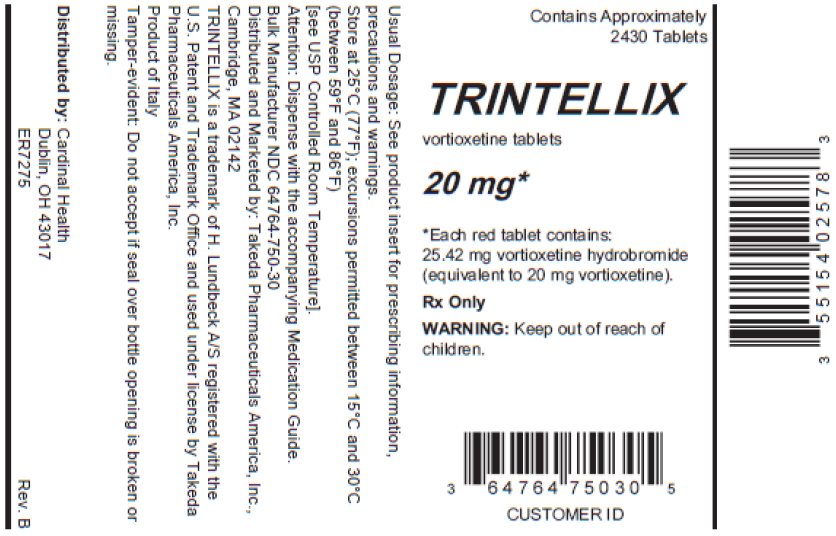
Tablets: 5 mg (pink, almond-shaped, biconvex, engraved with “TL” and "5"), 10 mg (yellow, almond-shaped, biconvex, engraved with “TL” and "10"), 15 mg (orange, almond-shaped, biconvex, engraved with “TL” and "15"), and 20 mg (red, almond-shaped, biconvex, engraved with “TL” and "20"). Blister: Pack size of 28.
Contraindications
TRINTELLIX is contraindicated in: • patients who are hypersensitive to vortioxetine or to any ingredient in the formulation, including any non-medicinal ingredient, or component of the container. Angioedema has been reported in patients treated with TRINTELLIX. • patients with concomitant use of monoamine oxidase inhibitors (MAOIs) (including linezolid, an antibiotic, methylene blue, a dye used in certain surgeries). At least 14 days should be allowed after discontinuing treatment with a MAOI before starting treatment with vortioxetine. At least 21 days should elapse after discontinuing vortioxetine treatment before starting a MAOI.
Warnings and precautions
Serious Warnings and Precautions: Increased risk of self-harm, harm to others, suicidal thinking and behavior with antidepressants use. Closely monitor all antidepressant-treated patients for clinical worsening and for emergence of agitation type and/or suicidal thoughts and behaviors. Dependence/Tolerance: No indication of drug-seeking behaviour in clinical trials. Physicians should carefully evaluate patients for history of drug abuse. Discontinuation Symptoms: Abrupt discontinuation was associated with discontinuation symptoms (nausea, sweating, dysphoric mood, irritability, agitation, dizziness, sensory disturbances, tremor, anxiety, confusion, headache, lethargy, emotional lability, insomnia, hypomania, tinnitus, and seizures). A gradual reduction in dose is recommended. Driving and Operating Machinery: Exercise caution until certain that TRINTELLIX does not adversely affect ability to engage in such activities. Hematologic (Abnormal Bleeding): May increase the risk of bleeding events by causing abnormal platelet aggregation. Caution with NSAIDs, ASA, warfarin. Hepatic/Biliary/Pancreatic (Hepatic Impairment): Caution advised in moderate or severe hepatic impairment. Musculoskeletal (Bone Fracture Risk): Increased risk of bone fractures with antidepressants. Neurologic (Seizures): Potential risk with antidepressant drugs. Introduce cautiously in patients with history of seizures or unstable epilepsy. Discontinue if seizures develop or increase in frequency. Serotonin Toxicity/Neuroleptic Malignant Syndrome: Rare occasions of serotonin toxicity reported, particularly with other serotonergic drugs. Clinical manifestations include hyperthermia, hypertonia, altered mental status, autonomic instability. Discontinuation should be considered if suspected. Ophthalmologic (Angle-Closure Glaucoma): Can cause mydriasis, which may trigger an angle-closure attack. Psychiatric (Potential Association with Behavioral and Emotional Changes, Including Self-Harm): Increased risk of suicidal ideation and behaviour in patients under 18. Rigorous clinical monitoring for suicidal ideation is advised. Activation of Mania/Hypomania: Use with caution in patients with history of mania/hypomania. Discontinue if manic phase occurs. Aggression/agitation: Patients may experience feelings of aggression, anger, agitation and irritability. Monitor closely. Electroconvulsive Therapy (ECT): Safety and efficacy of concurrent use not studied, caution advised. Renal (Hyponatraemia): Reported with SSRIs/SNRIs. Caution in patients at risk (elderly, cirrhotic, on diuretics, volume depleted). Discontinuation should be considered if symptomatic. Reproductive Health: Female and Male Potential (Fertility): No effect on male and female rat fertility. Function (Sexual Dysfunction): May cause symptoms of sexual dysfunction. Teratogenic Risk: Not teratogenic in rats or rabbits, but lower fetal weight and delayed ossification seen in animals. Pregnant Women: Not established in human pregnancy. Not recommended unless benefit outweighs risk. Discontinuation symptoms in newborn should be considered if used until or shortly before birth. Post-marketing reports indicate complications in neonates exposed to SNRIs/SSRIs late in third trimester. Increased risk of postpartum hemorrhage. Increased risk of persistent pulmonary hypertension in the newborn (PPHN). Breast-feeding: Expected to be excreted into human milk. Not recommended. Pediatrics: Not indicated for use in patients below 18 years of age. Controlled clinical studies in pediatrics with MDD failed to demonstrate efficacy. Higher incidences of headache, vomiting, abdominal pain-related events, and suicidal ideation/self-harm observed in pediatric patients.
What can be used instead?
Other Canadian products sharing ATC code N06AX26 VORTIOXETINE. 6 of 8 DINs in this group are currently marketed — marketed products are listed first, because that is what can actually be bought. These tables describe supply, not clinical equivalence: substitution rests with the prescriber or pharmacist, and interchangeability is determined provincially.
| Product | Strength | Form | Manufacturer | Health Canada status | DIN |
|---|---|---|---|---|---|
| APO-VORTIOXETINE | 10 MG | TABLET | APOTEX INC | MARKETED | DIN 02552752 |
| APO-VORTIOXETINE | 20 MG | TABLET | APOTEX INC | MARKETED | DIN 02552779 |
| APO-VORTIOXETINE | 5 MG | TABLET | APOTEX INC | MARKETED | DIN 02552744 |
| TRINTELLIX | 10 MG | TABLET | LUNDBECK CANADA INC | MARKETED | DIN 02432927 |
| TRINTELLIX | 20 MG | TABLET | LUNDBECK CANADA INC | MARKETED | DIN 02432943 |
| APO-VORTIOXETINE | 15 MG | TABLET | APOTEX INC | APPROVED | DIN 02552760 |
| TRINTELLIX | 15 MG | TABLET | LUNDBECK CANADA INC | APPROVED | DIN 02432935 |
How can I get it?
Nexara Health supplies this product to licensed Canadian buyers — pharmacies, hospitals, clinics, licensed distributors, and clinical trial sponsors or their CROs. We confirm stock, pack size, expiry and pricing at the time of quotation. If the product is on backorder or in shortage, we identify equivalent alternatives and import options where permitted.
Ordering questions
Who can buy this from Nexara?
Licensed entities only. Nexara holds Health Canada establishment licence DEL 3-002896-A and ships only to a licensed address.
Is there a minimum order?
Yes, set per product line and per pack multiple rather than on the order total, so you are never asked to buy a part-pack. The minimum for this line is confirmed with your quote.
What is the lead time?
Confirmed per order at quotation, and it depends on current stock position and whether the product is in shortage.
Can Nexara supply this for a clinical trial?
Yes — comparator and background-therapy supply, including sourcing from other markets where a Canadian pack will not satisfy the protocol. Clinical trial supply.