PARNATE 10 MG — DIN 01919598
TRANYLCYPROMINE (TRANYLCYPROMINE SULFATE) : 10 MG · GLAXOSMITHKLINE INC · TABLET · wholesale supply in Canada
Health Canada status: MARKETED
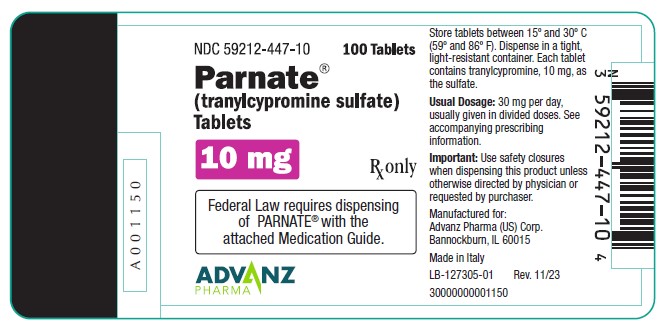
What is PARNATE?
PARNATE 10 MG contains TRANYLCYPROMINE (TRANYLCYPROMINE SULFATE) : 10 MG. It is listed in the Health Canada Drug Product Database under DIN 01919598, held by GLAXOSMITHKLINE INC, supplied as TABLET for ORAL administration. Health Canada currently lists it as marketed, status dated 16-Jul-2002. Nexara Health is a licensed Canadian wholesale distributor (DEL 3-002896-A) and can source this product for hospitals, pharmacies and clinics. Availability and lead time are confirmed per order.
What is PARNATE used for?
PARNATE (tranylcypromine sulfate) is indicated for the treatment of major depressive disorder (MDD) in adult patients who have not responded adequately to other antidepressants. PARNATE is not indicated for the initial treatment of MDD due to the potential for serious adverse reactions and drug interactions, and the need for dietary restrictions.
Authorized indication as written in the Health Canada product monograph. For healthcare professionals and licensed purchasers; this is not medical advice.
How much does Tranylcypromine cost around the world?
Tranylcypromine is listed on 3 of the national price registers Nexara ingests. Each country publishes on a different basis, so those figures are not comparable with one another — or with a Canadian wholesale price.
What a market publishes matters more than the number it publishes. Australia publishes a ex-manufacturer; South Africa publishes a single exit price; United Kingdom publishes a hospital. Comparing an ex-factory ceiling against a pharmacy public price tells you nothing about either, and comparing either against a Canadian landed cost tells you less.
| Market | Price basis published there | Brands | Packs listed | Range |
|---|---|---|---|---|
| Australia | ex-manufacturer | 2 | 4 | AUD███.██ |
| United Kingdom | hospital | 1 | 1 | GBP███.██ |
| South Africa | single exit price | 1 | 1 | ZAR███.██ |
6 pack listings across 4 brand entries and 3 price bases, refreshed 08 Sep 2026. Ranges span every Tranylcypromine pack in that market, so a high figure is usually a larger pack rather than the same product.
Canada publishes no comparable public list price. For a delivered Canadian price on a licensed account, verify your licence — it takes about a minute.
Is there a generic Tranylcypromine in Canada, and who makes it?
Every market authorization holder with a Canadian DIN for this molecule, and how many of their listings Health Canada currently shows as marketed.
2 holders have a Canadian DIN containing Tranylcypromine, across 2 DINs, of which 2 are currently marketed. Marketed count is the number that matters: an approval that is not marketed cannot be bought.
| Market authorization holder | DINs | Marketed | Brand names | Position |
|---|---|---|---|---|
| GLAXOSMITHKLINE INC | 1 | 1 | PARNATE | Sourceable in Canada |
| MANTRA PHARMA INC | 1 | 1 | M-TRANYLCYPROMINE | Sourceable in Canada |
Health Canada’s Drug Product Database does not flag which listing is the originator and which are subsequent-entry products, so Nexara does not label them here. Interchangeability is determined provincially, not federally — confirm for your province before a formulary switch. Nexara can confirm which of these is actually obtainable, and on what lead time, per order.
How is it supplied and stored?
Pack configuration, storage class and the handling constraints that drive cold-chain planning. One DIN can cover more than one pack size, and the pack — not the DIN — is what gets priced, shipped and invoiced.
| Strength on the label | 10 MG |
|---|---|
| Dosage form | TABLET |
| Route | ORAL |
| Pack configuration (monograph) | Available in bottles of 100 tablets. |
| Storage | PARNATE tablet should be stored at 15-30°C. Keep out of the sight and reach of children. |
Before an order line is unambiguous Nexara needs the strength, the pack size and the presentation, because this listing covers more than one of them.
Substance and classification
| Active substance | Tranylcypromine |
|---|---|
| ATC code | N06AF04 |
| AHFS class | 28:16.04.12 |
| Biosimilar biologic | No |
Health Canada record and identifiers
The regulatory facts straight from the Drug Product Database, plus every identifier form Nexara accepts on a purchase order. A DIN written without its leading zeros is the commonest reason an order line fails to match.
| DIN (8-digit, as used in ordering) | 01919598 |
|---|---|
| DIN (unpadded, as printed on some documents) | 1919598 |
| Brand name | PARNATE |
| Generic / active ingredient | TRANYLCYPROMINE (TRANYLCYPROMINE SULFATE) : 10 MG |
| Market authorization holder | GLAXOSMITHKLINE INC |
| Health Canada schedule | Prescription |
| ATC code | N06AF04 |
| ATC anatomical main group | N — Nervous system |
| ATC therapeutic subgroup | N06AF |
| Current status | MARKETED |
| Status date | 16-Jul-2002 |
| Original market date | 1992-12-31 00:00:00 |
| Status source | Live Health Canada DPD sync |
Verify on the primary sources
How is it administered?
Recommended starting dosage is 20 mg per day (10 mg in the morning and 10 mg in the afternoon). If no signs of a response appear within 2 to 3 weeks, increase dosage to 30 mg daily (20 mg in the morning and 10 mg in the afternoon). Continue this dosage for at least 1 week. If no improvement occurs, continued administration is unlikely to be beneficial. Although dosages above 30 mg per day have been used, consider that the incidence and severity of side effects may increase as dosage is raised. Dosage increases should be made in increments of 10 mg per day at intervals of 1 to 3 weeks to a maximum daily dose of 60 mg. When a satisfactory response is obtained, dosage may be reduced to a maintenance level. Some patients will be maintained on 20 mg per day; many will need only 10 mg daily. When Electroconvulsive therapy (ECT) is being administered concurrently with PARNATE, 10 mg BID can usually be given during the series, then reduced to 10 mg daily for maintenance therapy. Instruct patients to avoid foods and beverages with high tyramine content while being treated with PARNATE and for 2 weeks after stopping PARNATE, avoid use of all alcoholic beverages while taking PARNATE, and take their dose of PARNATE at approximately the same time each day. Taking the last dose before 3 p.m. may be a potential method for managing insomnia. In the case of a missed dose of PARNATE, instruct patients to take their next dose at its regularly scheduled time.
Included because it drives pack selection and wastage. Consult the monograph.
Contraindications
PARNATE is contraindicated in patients who are hypersensitive to this drug or to any ingredient in the formulation, including any non-medicinal ingredient, or component of the container. PARNATE is contraindicated in patients with cerebrovascular or cardiovascular disorders (e.g., arteriosclerosis, hypertension), history of recurrent or frequent headaches, liver damage or blood dyscrasias, phaeochromocytoma and catecholamine-releasing paragangliomas. PARNATE is contraindicated in combination with other monoamine oxidase inhibitors (MAOIs), selective serotonin reuptake inhibitors (SSRIs) or serotonin and noradrenaline reuptake inhibitors (SNRIs), tricyclic antidepressants, other antidepressant drugs (e.g. amoxapine, bupropion, maprotiline, nefazodone, trazodone, vilazodone, vortioxetine), serotonin releasing agents (e.g. amphetamine and methylphenidate and their derivatives), triptans (e.g. sumatriptan or rizatriptan), sympathomimetics (e.g. pseudoephedrine, phenylephedine, ephedrine, methyldopa, dopamine, and levodopa and tryptophan), other individual drugs (buspirone, carbamazepine, cyclobenzaprine, dextromethorphan, dopamine, hydroxytryptophan, levodopa, meperidine, methyldopa, milnacipran, rasagiline, reserpine, s-adenosyl-L-methionine (SAM-e), tapentadol, tetrabenazine, tryptophan), and foods and beverages with a high tyramine content.
Warnings and precautions
Antidepressants increased the risk of suicidal thoughts and behaviors in pediatric and young adult patients in short-term studies. Closely monitor all antidepressant-treated patients for clinical worsening, and for emergence of suicidal thoughts and behaviors. PARNATE is not approved for use in pediatric patients. Hypertensive crisis: When excessive amounts of tyramine are consumed in conjunction with PARNATE, or within 2 weeks of stopping treatment, a serious and sometimes fatal hypertensive reaction may occur. The most important adverse reaction associated with PARNATE is hypertensive crisis, which has sometimes been fatal. This response is not usually dose-related. It is associated with a distinctive reaction characterized by some or all of the following symptoms: occipital headache which may radiate frontally, palpitation, neck stiffness or soreness, nausea or vomiting, sweating (sometimes with fever and sometimes with cold, clammy skin) with early pallor followed later by flushing, and photophobia. Either tachycardia or bradycardia may be present, sometimes associated with constricting chest pain. Mydriasis may occur. The occipital headache, together with pain and stiffness in the cervical muscles, may mimic subarachnoid hemorrhage, but can equally be associated with actual intracranial bleeding, as in other conditions where a sudden rise in blood pressure occurs. Cases of such bleeding have been reported, some of which have been fatal. Blood pressure should be followed closely in patients taking PARNATE to detect evidence of any pressor response. If a hypertensive reaction occurs, PARNATE should be discontinued. Patients should be managed according to standard of care. Hypotension, which may be postural, has been observed during PARNATE therapy, particularly at doses above 30 mg daily. It is seen most commonly (but not exclusively) in patients with pre-existing hypertension. Rare instances of syncope have been seen. Dosage increases should be made more gradually in patients showing a tendency toward hypotension at the starting dose. Postural hypotension can usually be relieved by having the patient lie down until blood pressure returns to normal. This side effect is usually temporary, but if it persists, PARNATE should be discontinued. When PARNATE is combined with phenothiazine derivatives or other compounds known to cause hypotension, the possibility of additive hypotensive effects should be considered. MAOIs may have the capacity to suppress anginal pain that would otherwise serve as a warning of myocardial ischemia. There have been reports of drug dependency in patients using doses of PARNATE significantly in excess of the therapeutic range. Some of these patients had a history of previous substance abuse. PARNATE should be tapered according to the patient's clinical reaction when discontinuation is necessary. Symptoms reported after stopping PARNATE without tapering include sleep disturbances, depression, confusion, delirium, tremor, agitation, convulsion, anxiety, hallucinations, fatigue, and headache. Some PARNATE adverse reactions (e.g. dizziness, drowsiness, etc.) may affect the patient's ability to drive or operate machinery. For patients who experience these symptoms, due caution should be exercised when driving or operating a vehicle or potentially dangerous machinery. PARNATE may cause an acute attack of glaucoma. Having your eyes examined before you take this drug could help identify if you are at risk of having angle-closure glaucoma.
What can be used instead?
Alternatives on every axis a buyer actually considers — the same molecule in another presentation, the same class, an adjacent class, or a fixed-dose combination. Every row is led by the marketed DIN count, because that is what can be bought this week.
1 · Same molecule, other Canadian presentations
2 of 2 Canadian DINs for this molecule are currently marketed. Marketed products are listed first.
| Product | Strength | Form | Holder | Health Canada status | DIN |
|---|---|---|---|---|---|
| M-TRANYLCYPROMINE | 10 MG | TABLET | MANTRA PHARMA INC | MARKETED | 02542188 |
2 · Same class — other molecules in ATC N06AF
| Molecule | Canadian brands | DINs | Marketed | Sourceable |
|---|---|---|---|---|
| Tranylcypromine | M-TRANYLCYPROMINE · PARNATE | 2 | 2 | Yes |
A molecule with zero marketed DINs cannot be sourced domestically, however many approvals it holds — if one of these sits on a formulary or in an older protocol, that is the line to check.
3 · Adjacent classes in ATC N06A
| ATC subgroup | Molecules | DINs | Marketed |
|---|---|---|---|
| N06AB | Citalopram · Escitalopram · Fluoxetine · Fluvoxamine · Paroxetine · +1 more | 589 | 248 |
| N06AX | Bupropion · Desvenlafaxine · Duloxetine · Esketamine · Levomilnacipran · +7 more | 386 | 181 |
| N06AA | Amitriptyline · Amoxapine · Clomipramine · Desipramine · Doxepin · +5 more | 325 | 62 |
| N06AG | Moclobemide | 21 | 4 |
Not clinical advice. These tables describe what can be supplied in Canada, not what should be prescribed. Substitution within or across classes is a prescriber and pharmacist decision, and interchangeability is determined provincially.
What else is PARNATE called?
Also recorded in Canada as: Tranylcypromine Sulfate (US), Tranylcypromine Sulphate (UK), Tranylcypromine Sulfate (JP), Tranylcypromine (GLOBAL), Stelazine-Parnate (IN).
The same molecule, Tranylcypromine, is registered under other names elsewhere. Buyers and prescribers searching from outside Canada — or working from a foreign prescription or tender document — often know it by one of these:
| Name | Script | Registered in |
|---|---|---|
| TRANYLMED | Latin | Australia |
Names are taken from national medicine registers and published price lists. A product registered abroad is not authorized for sale in Canada unless it holds its own DIN; import is possible only through the routes Health Canada permits.
How can I get it?
Nexara Health supplies this product to licensed Canadian buyers — pharmacies, hospitals, clinics, licensed distributors, and clinical trial sponsors or their CROs. We confirm stock, pack size, expiry and pricing at the time of quotation. If the product is on backorder or in shortage, we identify equivalent alternatives and import options where permitted.
Ordering questions
Who can buy this from Nexara?
Licensed entities only. Nexara holds Health Canada establishment licence DEL 3-002896-A and ships only to a licensed address. Patients and unlicensed buyers are routed to a partner pharmacy.
Is there a minimum order?
Yes, set per product line and per pack multiple rather than on the order total, so you are never asked to buy a part-pack. The minimum for this line is confirmed with your quote.
What is the lead time?
Confirmed per order at quotation, and it depends on current stock position and whether the product is in shortage.
Why is there no price on this page?
Nexara quotes a delivered Canadian price per order, against a verified licence. Foreign list prices are published on incompatible bases and are not a guide to what any buyer can obtain here, so this page shows which markets list the molecule and on what basis, and nothing more.
Can Nexara supply this for a clinical trial?
Yes — comparator and background-therapy supply, including sourcing from other markets where a Canadian pack will not satisfy the protocol. Clinical trial supply.