AZACITIDINE FOR INJECTION 100 MG
AZACITIDINE : 100 MG · DIN 02462826 · DR REDDY'S LABORATORIES LTD
Health Canada status: MARKETED
What is AZACITIDINE FOR INJECTION?
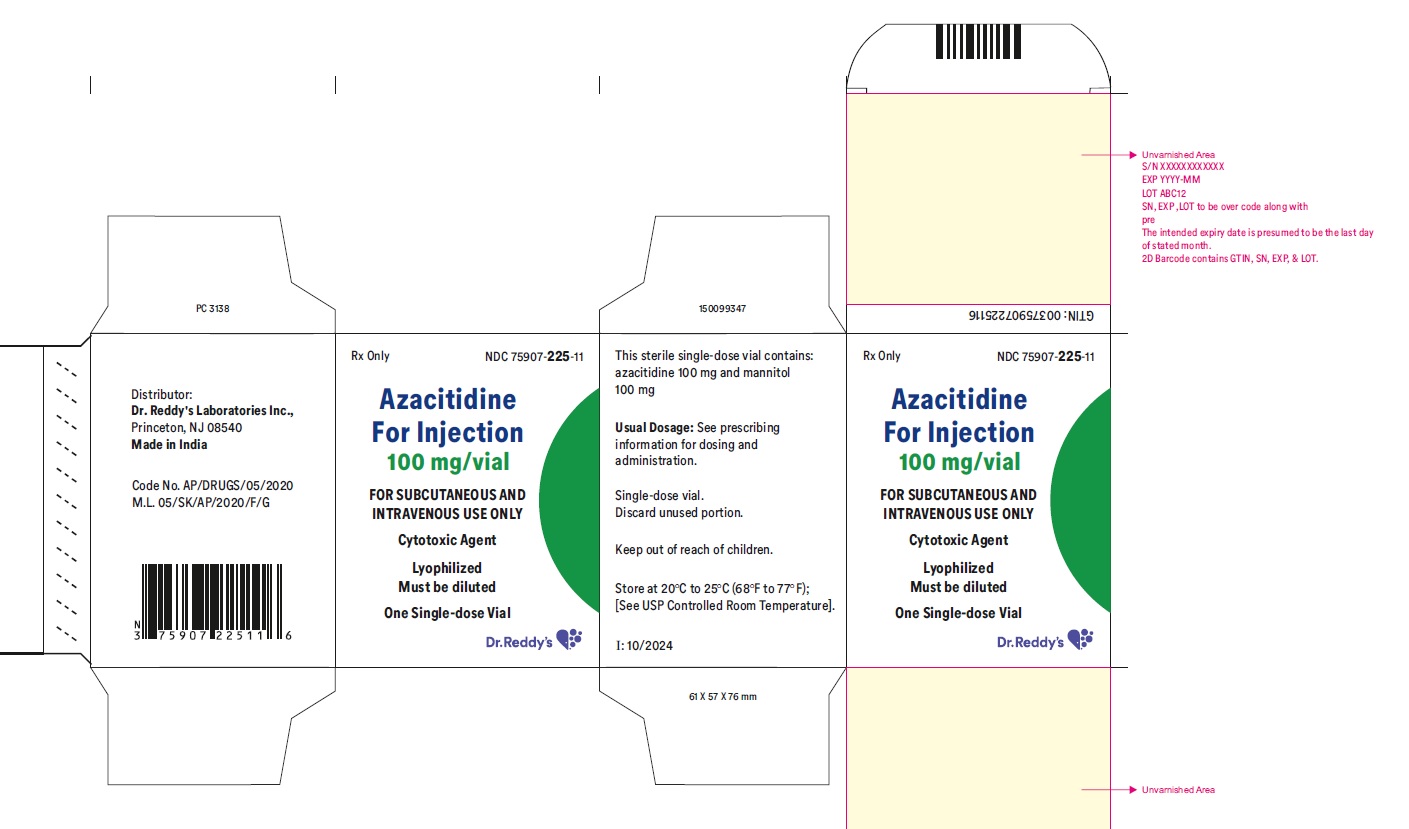
AZACITIDINE FOR INJECTION 100 MG contains AZACITIDINE : 100 MG. It is listed in the Health Canada Drug Product Database under DIN 02462826, held by DR REDDY'S LABORATORIES LTD, supplied as POWDER FOR SUSPENSION for SUBCUTANEOUS administration. Health Canada currently lists it as marketed, status dated 25-Oct-2017. Nexara Health is a licensed Canadian wholesale distributor (DEL 3-002896-A) and can source this product for hospitals, pharmacies and clinics. Availability and lead time are confirmed per order.
What is AZACITIDINE FOR INJECTION used for?
AZACITIDINE FOR INJECTION (azacitidine for injection) is indicated for the treatment of adult patients who are not eligible for hematopoietic stem cell transplantation with: • Intermediate-2 and High-risk Myelodysplastic Syndrome (MDS) according to the International Prognostic Scoring System (IPSS), • Acute Myeloid Leukemia (AML) with 20-30% blasts and multi lineage dysplasia, according to World Health Organization (WHO) classification
Authorized indication as written in the Health Canada product monograph. For healthcare professionals and licensed purchasers; this is not medical advice.
Product details and regulatory record
| DIN | 02462826 |
|---|---|
| Brand name | AZACITIDINE FOR INJECTION |
| Generic / active ingredient | AZACITIDINE : 100 MG |
| Manufacturer | DR REDDY'S LABORATORIES LTD |
| Strength | 100 MG |
| Dosage form | POWDER FOR SUSPENSION |
| Route of administration | SUBCUTANEOUS |
| Schedule | Prescription |
| ATC code | L01BC07 AZACITIDINE |
| AHFS class | 10:00.00 |
| Biosimilar | No |
| Health Canada status | MARKETED |
| Status date | 25-Oct-2017 |
| Original market date | 2017-10-25 00:00:00 |
How is it administered?
The recommended starting dose for the first treatment cycle, for all patients regardless of baseline hematology laboratory values, is 75 mg/m² of body surface area, injected subcutaneously, daily for 7 consecutive days, followed by a rest period of 21 days (28-day treatment cycle). It is recommended that patients be treated for a minimum of 6 cycles unless unacceptable toxicities occur after dose delays / adjustments or standard supportive care such as transfusions, growth factors or antibiotics have proved to be unsuccessful. Treatment should be continued as long as the patient continues to benefit or until disease progression. Patients should be monitored for hematologic response/toxicity and renal toxicities. A delay in starting the next cycle or a dose reduction may be necessary. Renal impairment: AZACITIDINE FOR INJECTION can be administered to patients with renal impairment without initial dose adjustment. If unexplained reductions in serum bicarbonate levels to less than 20 mmol/L occur, the dose should be reduced by 50% on the next cycle. If unexplained elevations in serum creatinine or BUN to ≥ 2 fold above baseline values and above ULN occur, the next cycle should be delayed until values return to normal or baseline. The dose should be reduced by 50% on the next treatment cycle. Patients with renal impairment should be closely monitored for toxicity since AZACITIDINE FOR INJECTION and/or its metabolites are primarily excreted through the kidney. Hepatic impairment: Patients with impaired liver function were excluded from the pivotal clinical trial. These patients should be treated with caution. AZACITIDINE FOR INJECTION is contraindicated in patients with advanced malignant hepatic tumors. Reconstituted AZACITIDINE FOR INJECTION should be injected subcutaneously (insert the needle at a 45-90° angle) using a 25-gauge needle into the upper arm, thigh or abdomen. Doses requiring more than 1 vial should be injected into two separate sites. Injection sites should be rotated. New injections should be given at least 2.5 cm from the previous site and never into areas where the site is tender, bruised, red, or hardened. If a dose is missed during the 7-day cycle, it should not be administered at the same time as the next dose, but should be added to the end of the current dosing cycle.
Included because it drives pack selection and wastage. Consult the monograph.
How is it stored and handled?
Store at room temperature (15 to 30°C). Chemical and physical in use stability of the reconstituted medicinal product has been demonstrated at 25°C for 45 minutes and at 2°C to 8°C for 8 hours. From a microbiological point of view, the reconstituted product should be used immediately. If not used immediately, in use storage times and conditions prior to use are the responsibility of the user and must not be longer than 8 hours at 2°C to 8°C.
How is it supplied?
AZACITIDINE FOR INJECTION (azacitidine for injection) is supplied in 100 mg and 150 mg single-use vials packaged in cartons of 1 vial. The vial stopper is not made with natural rubber latex. Each 100 mg vial of AZACITIDINE FOR INJECTION contains 100 mg of azacitidine and 100 mg mannitol as a sterile white lyophilized powder for reconstitution as a suspension for subcutaneous injection. Preservative free. Each 150 mg vial of AZACITIDINE FOR INJECTION contains 150 mg of azacitidine and 150 mg mannitol as a sterile white lyophilized powder for reconstitution as a suspension for subcutaneous injection. Preservative free. AZACITIDINE FOR INJECTION is packed in type I flint tubular glass vial, stoppered with 20 mm bromobutyl and sealed with 20 mm violet flip off seal.
Contraindications
• Patients who are hypersensitive to azacitidine or to any ingredient in the formulation or component of the container. • Advanced malignant hepatic tumors.
Warnings and precautions
Serious Warnings and Precautions: • Thrombocytopenia • Renal failure, including fatalities • Differentiation Syndrome AZACITIDINE FOR INJECTION should be administered under the supervision of a qualified physician experienced in the use of cancer chemotherapeutic agents. Tumor Lysis Syndrome (TLS): There have been reports of Tumor Lysis Syndrome (TLS) in patients treated with azacitidine for injection in the postmarketing setting. Patients at risk for TLS are those with high tumor burden prior to treatment. These patients should be monitored closely and appropriate precautions taken. Differentiation Syndrome: Cases of differentiation syndrome (also known as retinoic acid syndrome) have been reported in patients receiving injectable azacitidine. Differentiation syndrome may be fatal, and symptoms and clinical findings include respiratory distress, pulmonary infiltrates, fever, rash, pulmonary oedema, peripheral oedema, rapid weight gain, pleural effusions, pericardial effusions, hypotension and renal dysfunction. Treatment with high-dose IV corticosteroids and hemodynamic monitoring should be considered at first onset of symptoms or signs suggestive of differentiation syndrome. Temporary discontinuation of injectable azacitidine should be considered until resolution of symptoms and if resumed, caution is advised. Hematologic: Treatment with azacitidine for injection is associated with anemia, neutropenia and thrombocytopenia, particularly during the first 2 cycles. Complete blood counts should be performed as needed to monitor response and toxicity, but at least prior to each treatment cycle. After administration of the recommended dose for the first cycle, the dose for subsequent cycles should be reduced or its administration delayed based on nadir counts and hematological response. Patients should be advised to promptly report febrile episodes. Patients and physicians should be observant for signs and symptoms of bleeding, particularly in case of pre-existing or treatment-related thrombocytopenia. Physicians should be prepared to provide appropriate supportive measures (e.g., transfusions for anemia and thrombocytopenia, growth factors and/or prophylactic antibiotics for neutropenia). Hepatic/Biliary/Pancreatic: Patients with extensive tumor burden due to metastatic disease have been rarely reported to experience progressive hepatic coma and death during azacitidine for injection treatment, especially in such patients with baseline serum albumin < 30 g/L. AZACITIDINE FOR INJECTION is contraindicated in patients with advanced malignant hepatic tumors. Renal: Renal abnormalities ranging from elevated serum creatinine to renal failure and death were reported rarely in patients treated with intravenous azacitidine for injection in combination with other chemotherapeutic agents. Severe renal tubular dysfunction may infrequently accompany AZACITIDINE FOR INJECTION therapy and may be manifested as hypophosphatemia, hypokalemia, or hyponatremia, with or without increases in serum creatinine and blood urea nitrogen (BUN). In addition, renal tubular acidosis, defined as a fall in serum bicarbonate to <20 mmol/L in association with an alkaline urine and hypokalaemia (serum potassium <3 mmol/L) was reported in 5 subjects with chronic myelogenous leukemia (CML) treated with azacitidine for injection and etoposide. Serum electrolytes, bicarbonate (serum CO2), creatinine, and BUN should be monitored periodically. If unexplained reductions in serum bicarbonate (< 20 mmol/L) or elevations of serum creatinine or BUN occur, the dose should be reduced or administration delayed. Skin: Necrotizing fasciitis, including fatal cases, has been reported in patients treated with azacitidine for injection. AZACITIDINE FOR INJECTION therapy should be discontinued in patients who develop necrotizing fasciitis, and appropriate treatment should be promptly initiated. Reports of injection site necrosis have been received for patients treated with azacitidine
Is AZACITIDINE in shortage in Canada?
A Canadian shortage report is on file for this molecule: Resolved — reported by SANDOZ CANADA INCORPORATED, last seen 04 Sep 2026. A shortage on one presentation does not always affect every DIN of the molecule — the alternatives below list what else is marketed in Canada. Nexara can confirm current availability and identify substitutions or import options where permitted.
What can be used instead?
Other Canadian products sharing ATC code L01BC07 AZACITIDINE. 7 of 14 DINs in this group are currently marketed — marketed products are listed first, because that is what can actually be bought. These tables describe supply, not clinical equivalence: substitution rests with the prescriber or pharmacist, and interchangeability is determined provincially.
| Product | Strength | Form | Manufacturer | Health Canada status | DIN |
|---|---|---|---|---|---|
| AZACITIDINE FOR INJECTION | 100 MG | POWDER FOR SUSPENSION | HIKMA CANADA LIMITED | MARKETED | DIN 02507668 |
| AZACITIDINE FOR INJECTION | 100 MG | POWDER FOR SUSPENSION | SANDOZ CANADA INCORPORATED | MARKETED | DIN 02529599 |
| AZACITIDINE FOR INJECTION | 100 MG | POWDER FOR SUSPENSION | FRESENIUS KABI CANADA LTD | MARKETED | DIN 02505177 |
| ONUREG | 200 MG | TABLET | BRISTOL-MYERS SQUIBB CANADA | MARKETED | DIN 02510197 |
| ONUREG | 300 MG | TABLET | BRISTOL-MYERS SQUIBB CANADA | MARKETED | DIN 02510200 |
| VIDAZA | 100 MG | POWDER FOR SUSPENSION | BRISTOL-MYERS SQUIBB CANADA | MARKETED | DIN 02336707 |
| AZACITIDINE FOR INJECTION | 100 MG | POWDER FOR SUSPENSION | JAMP PHARMA CORPORATION | DORMANT | DIN 02501791 |
| AZACITIDINE FOR INJECTION | 100 MG | POWDER FOR SUSPENSION | STERIMAX INC | APPROVED | DIN 02534029 |
| AZACITIDINE FOR INJECTION | 150 MG | POWDER FOR SUSPENSION | STERIMAX INC | APPROVED | DIN 02534037 |
| AZACITIDINE FOR INJECTION | 150 MG | POWDER FOR SUSPENSION | DR REDDY'S LABORATORIES LTD | APPROVED | DIN 02558815 |
Who else supplies AZACITIDINE worldwide?
Nexara tracks national medicine registries and published price lists across multiple markets. AZACITIDINE appears in 411 registered pack listings across 10 markets, published on 7 different national price bases. Where a Canadian route is closed, that is where an alternative route of supply starts — subject to the import rules in both countries.
Registered listings are not stock. Ask us to confirm what can actually be sourced for your order.
How can I get it?
Nexara Health supplies this product to licensed Canadian buyers — pharmacies, hospitals, clinics, licensed distributors, and clinical trial sponsors or their CROs. We confirm stock, pack size, expiry and pricing at the time of quotation. If the product is on backorder or in shortage, we identify equivalent alternatives and import options where permitted.
Ordering questions
Who can buy this from Nexara?
Licensed entities only. Nexara holds Health Canada establishment licence DEL 3-002896-A and ships only to a licensed address.
Is there a minimum order?
Yes, set per product line and per pack multiple rather than on the order total, so you are never asked to buy a part-pack. The minimum for this line is confirmed with your quote.
What is the lead time?
Confirmed per order at quotation, and it depends on current stock position and whether the product is in shortage.
Can Nexara supply this for a clinical trial?
Yes — comparator and background-therapy supply, including sourcing from other markets where a Canadian pack will not satisfy the protocol. Clinical trial supply.