ZOLADEX 3.6 MG
GOSERELIN (GOSERELIN ACETATE) : 3.6 MG · DIN 02049325 · TERSERA THERAPEUTICS LLC
Health Canada status: MARKETED
What is ZOLADEX?
ZOLADEX 3.6 MG contains GOSERELIN (GOSERELIN ACETATE) : 3.6 MG. It is listed in the Health Canada Drug Product Database under DIN 02049325, held by TERSERA THERAPEUTICS LLC, supplied as IMPLANT for SUBCUTANEOUS administration. Health Canada currently lists it as marketed, status dated 28-Feb-2018. Nexara Health is a licensed Canadian wholesale distributor (DEL 3-002896-A) and can source this product for hospitals, pharmacies and clinics. Availability and lead time are confirmed per order.
What is ZOLADEX used for?
ZOLADEX® (goserelin acetate) is indicated for a number of hormone-dependent conditions: Prostate Cancer: • Palliative treatment of patients with hormone-dependent advanced carcinoma of the prostate (Stage M1 or Stage D2). • Use in combination with a non-steroidal antiandrogen and radiation therapy for the management of locally advanced (T3, T4) or bulky Stage T2b, T2c carcinoma of the prostate. Treatment should start 8 weeks prior to initiating radiation therapy and continue until completion. • Adjuvant hormone therapy to external beam irradiation for patients with locally advanced prostate cancer (Stage T3-T4). Breast Cancer: • Alternative to standard adjuvant chemotherapy in pre- and perimenopausal women with early breast cancer who are unsuitable for, intolerant to, or decline chemotherapy, and whose tumour contains estrogen and/or progesterone receptors. • Palliative treatment of advanced breast cancer in pre- and perimenopausal women whose tumour contains estrogen and/or progesterone receptors. Benign Conditions: • Hormonal management of endometriosis, including pain relief and reduction of endometriotic lesions. Limited to women 18 years of age and older, treated for 6 months. • Use as an endometrial thinning agent prior to endometrial ablation.
Authorized indication as written in the Health Canada product monograph. For healthcare professionals and licensed purchasers; this is not medical advice.
Product details and regulatory record
| DIN | 02049325 |
|---|---|
| Brand name | ZOLADEX |
| Generic / active ingredient | GOSERELIN (GOSERELIN ACETATE) : 3.6 MG |
| Manufacturer | TERSERA THERAPEUTICS LLC |
| Strength | 3.6 MG |
| Dosage form | IMPLANT |
| Route of administration | SUBCUTANEOUS |
| Schedule | Prescription |
| ATC code | L02AE03 GOSERELIN |
| AHFS class | 68:18.00 |
| Biosimilar | No |
| Health Canada status | MARKETED |
| Status date | 28-Feb-2018 |
| Original market date | 1994-12-31 00:00:00 |
How is it administered?
ZOLADEX should be administered by a healthcare professional experienced in administering deep subcutaneous injections and under the supervision of a physician. Breast Cancer: ZOLADEX depot, containing goserelin acetate equivalent to 3.6 mg goserelin, should be administered subcutaneously every 28 days into the anterior abdominal wall following the procedure recommended in the administration instructions. Prostate Cancer: When ZOLADEX is given in combination with a non-steroidal antiandrogen and radiotherapy for patients with Stage T2b-T4 prostatic carcinoma, treatment should be started 8 weeks prior to initiating radiotherapy and should continue until completion of the radiation therapy. A treatment regimen using a ZOLADEX 3.6 mg depot 8 weeks before radiotherapy, followed in 28 days by the ZOLADEX LA (10.8 mg) depot, can be administered by injection subcutaneously into the anterior abdominal wall. Alternatively, four injections of the ZOLADEX 3.6 mg depot subcutaneously into the anterior abdominal wall can be administered at 28 day intervals, two depots preceding and two during radiotherapy until completion of the radiation therapy. Endometriosis: One depot of ZOLADEX containing goserelin acetate equivalent to 3.6 mg goserelin, should be injected subcutaneously into the anterior abdominal wall every 28 days following the procedure recommended in the administration instructions. Endometrial Thinning: For use as an endometrial thinning agent prior to endometrial ablation, ZOLADEX should be administered by subcutaneous injection into the anterior abdominal wall as two 3.6 mg depots, four weeks apart, with surgery planned for between 0 and 2 weeks after the second depot injection. Administration: ZOLADEX is administered by deep subcutaneous injection into the anterior abdominal wall below the navel line. Caution should be taken while injecting ZOLADEX due to the proximity of underlying inferior epigastric artery and its branches. Follow all administration instructions. Use only if pouch is undamaged. Use immediately after opening pouch. Do not depress plunger until Step 5. Read all instructions before use.
Included because it drives pack selection and wastage. Consult the monograph.
How is it stored and handled?
Protect from light and moisture. Store in the intact package between 2°C and 25°C. Do not use after the expiry date on the pack. Return to pharmacy for proper disposal if treatment is stopped. Keep in a safe place where children cannot reach it.
How is it supplied?
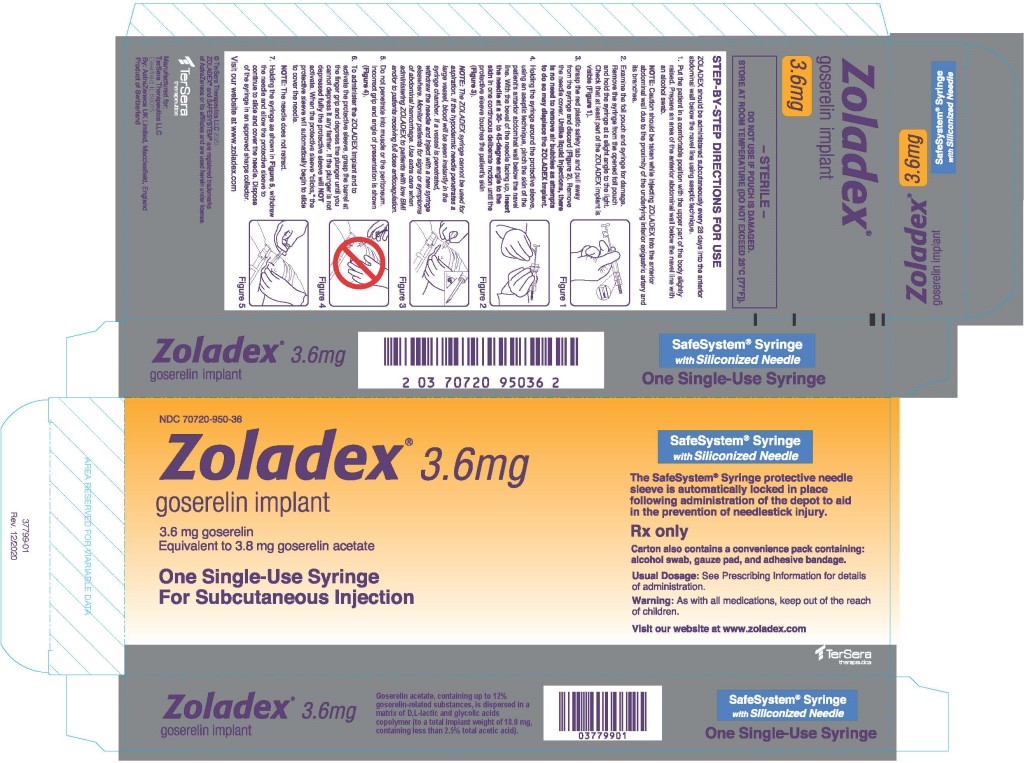
ZOLADEX (goserelin acetate) depot is supplied as a cylindrical rod of biodegradable and biocompatible D-L Lactide-glycolide copolymer. Each ZOLADEX depot contains goserelin acetate equivalent to 3.6 mg of goserelin. This depot is presented in a sterile ready-to-use syringe with a 16 gauge needle for a single subcutaneous injection. This single-dose syringe is assembled with a protective sleeve (SafeSystem™) in a sealed, sterile pouch that contains a desiccant. Instructions for administration, once every 28 days, are attached.
Contraindications
• Patients who are hypersensitive to this drug or to any ingredient in the formulation or component of the container. • Women having undiagnosed abnormal vaginal bleeding. • Pregnancy: ZOLADEX should not be used during pregnancy. Women of child bearing potential should be carefully examined before treatment to exclude pregnancy. Non-hormonal methods of contraception should be employed during therapy. • Lactation: The use of ZOLADEX during breast feeding is not recommended.
Warnings and precautions
Serious Warnings and Precautions: ZOLADEX (goserelin acetate) should be prescribed by a qualified physician experienced in the use of hormonal therapy in cancer and endometriosis. ZOLADEX should be administered by a healthcare professional experienced in administering deep subcutaneous injections and under the supervision of a physician. Clinically significant adverse events: • Tumour flare reaction • Osteoporosis • Injection site injuries and vascular injuries General: Injection site injury and vascular injury including pain, hematoma, hemorrhage and hemorrhagic shock, requiring blood transfusions and surgical intervention, have been reported with ZOLADEX. Monitor patients for signs or symptoms of abdominal hemorrhage. Not recommended in patients with low body mass index (BMI <18.5) or in patients who are fully anticoagulated (INR >2) due to the risk of vascular injury and subsequent bleeding. Initially, ZOLADEX transiently increases serum testosterone in males and serum estradiol concentrations in females and other gonadal hormones. Worsening of signs and symptoms may occur during the first four weeks of therapy, occasionally requiring discontinuation or surgical intervention. Effect on ability to drive a vehicle and use machinery: No evidence that ZOLADEX impairs ability to drive or operate machinery. Tumour Flare Reaction: Patients with genitourinary tract symptoms: Close monitoring during the first month of therapy for ureteric obstruction. Patients with vertebral metastases: Close monitoring during the first month of therapy for spinal cord compression. If spinal cord compression or renal impairment due to ureteric obstruction are present or develop, treatment of these complications should be instituted according to current local clinical practice. Cardiovascular: Androgen deprivation therapy may increase cardiovascular risk in men with prostate cancer by increasing body weight, reducing insulin sensitivity, and/or resulting in dyslipidemia. Heart failure was commonly reported. Assessment of cardiovascular risk and management according to local clinical practice and guidelines should be considered. Androgen deprivation therapy has the potential to prolong QT/QTc interval on ECG. Physicians should consider whether benefits outweigh risks in patients with a history of QT prolongation, congenital long QT syndrome, electrolyte abnormalities, or congestive heart failure, and in patients taking Class IA, Class III, or Class IC antiarrhythmic medications. Periodic monitoring of ECG and serum electrolyte levels should be considered in patients at risk. Endocrine and Metabolism: Males: Induced hypogonadism. Impaired glucose tolerance has been observed; monitor blood glucose. Hematologic: Anemia is a known physiologic consequence of testosterone suppression; assess anemia risk and manage according to clinical practice. Musculoskeletal: Reduction in bone mineral density, increased risks of osteoporosis and skeletal bone fractures. Assess osteoporosis risk and manage according to clinical practice. In women treated for endometriosis, use for longer than 6 months or with other risk factors for decreased bone mineral content may cause additional bone loss. Psychiatric: Depression (sometimes severe) has been reported. Patients should be informed of risks, monitored, and treated accordingly. Sexual Function/Reproduction: Fertility: Suppression of serum estradiol will induce amenorrhea in the majority of patients after the first four weeks of treatment. Vaginal bleeding of variable duration and intensity may occur early in treatment. Amenorrhea is expected to be maintained until 4 weeks after the last dose. Menses usually resumed within 8 weeks following completion of therapy. Rarely, some women may enter natural menopause and not resume menses. Time to return of menses may be prolonged in some patients. A non-hormonal method of contraception should be used during treatment. If a patient becomes pregnant, she should discontinue t
What can be used instead?
Other Canadian products sharing ATC code L02AE03 GOSERELIN. 2 of 2 DINs in this group are currently marketed — marketed products are listed first, because that is what can actually be bought. These tables describe supply, not clinical equivalence: substitution rests with the prescriber or pharmacist, and interchangeability is determined provincially.
| Product | Strength | Form | Manufacturer | Health Canada status | DIN |
|---|---|---|---|---|---|
| ZOLADEX LA | 10.8 MG | IMPLANT | TERSERA THERAPEUTICS LLC | MARKETED | DIN 02225905 |
Who else supplies GOSERELIN worldwide?
Nexara tracks national medicine registries and published price lists across multiple markets. GOSERELIN appears in 37 registered pack listings across 12 markets, published on 10 different national price bases. Where a Canadian route is closed, that is where an alternative route of supply starts — subject to the import rules in both countries.
Registered listings are not stock. Ask us to confirm what can actually be sourced for your order.
How can I get it?
Nexara Health supplies this product to licensed Canadian buyers — pharmacies, hospitals, clinics, licensed distributors, and clinical trial sponsors or their CROs. We confirm stock, pack size, expiry and pricing at the time of quotation. If the product is on backorder or in shortage, we identify equivalent alternatives and import options where permitted.
Ordering questions
Who can buy this from Nexara?
Licensed entities only. Nexara holds Health Canada establishment licence DEL 3-002896-A and ships only to a licensed address.
Is there a minimum order?
Yes, set per product line and per pack multiple rather than on the order total, so you are never asked to buy a part-pack. The minimum for this line is confirmed with your quote.
What is the lead time?
Confirmed per order at quotation, and it depends on current stock position and whether the product is in shortage.
Can Nexara supply this for a clinical trial?
Yes — comparator and background-therapy supply, including sourcing from other markets where a Canadian pack will not satisfy the protocol. Clinical trial supply.