OPZELURA 1.5 %
RUXOLITINIB (RUXOLITINIB PHOSPHATE) : 1.5 % · DIN 02552434 · INCYTE CORPORATION
Health Canada status: MARKETED
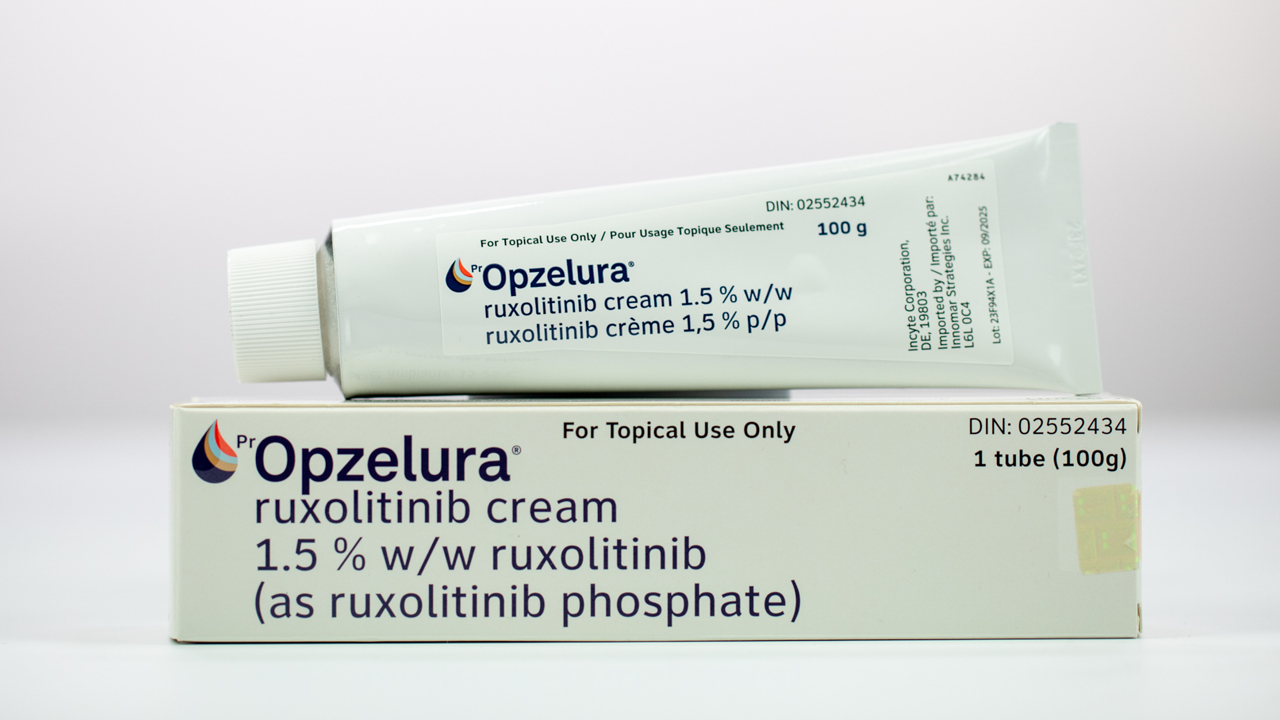
What is OPZELURA?
OPZELURA 1.5 % contains RUXOLITINIB (RUXOLITINIB PHOSPHATE) : 1.5 %. It is listed in the Health Canada Drug Product Database under DIN 02552434, held by INCYTE CORPORATION, supplied as CREAM for TOPICAL administration. Health Canada currently lists it as marketed, status dated 28-Nov-2024. Nexara Health is a licensed Canadian wholesale distributor (DEL 3-002896-A) and can source this product for hospitals, pharmacies and clinics. Availability and lead time are confirmed per order.
What is OPZELURA used for?
OPZELURA (ruxolitinib (as ruxolitinib phosphate)) cream 1.5% is indicated for: • topical treatment of nonsegmental vitiligo in adult and pediatric patients 12 years of age and older. • topical treatment of mild to moderate atopic dermatitis in adult and pediatric patients 2 years of age and older whose disease is not adequately controlled with conventional topical prescription therapies (topical corticosteroids, topical calcineurin inhibitors) or when those therapies are not advisable. Limitations of Use: Use of OPZELURA in combination with other JAK inhibitors, biological immunomodulators or potent immunosuppressants has not been studied and is not recommended.
Authorized indication as written in the Health Canada product monograph. For healthcare professionals and licensed purchasers; this is not medical advice.
Product details and regulatory record
| DIN | 02552434 |
|---|---|
| Brand name | OPZELURA |
| Generic / active ingredient | RUXOLITINIB (RUXOLITINIB PHOSPHATE) : 1.5 % |
| Manufacturer | INCYTE CORPORATION |
| Strength | 1.5 % |
| Dosage form | CREAM |
| Route of administration | TOPICAL |
| Schedule | Prescription |
| ATC code | D11AH09 RUXOLITINIB |
| Biosimilar | No |
| Health Canada status | MARKETED |
| Status date | 28-Nov-2024 |
How is it administered?
OPZELURA is for topical use only. OPZELURA is not for ophthalmic, oral, or intravaginal use. In order to avoid ingestion of cream, do not apply to the lips. OPZELURA should be applied topically twice daily to affected areas of skin with a minimum of 8 hours between applications. Patients should be instructed to wash their hands after applying OPZELURA, unless their hands are being treated. If someone else applies OPZELURA onto the patient, they should wash their hands after application. Vitiligo: Do not use more than one 60 gram tube per week or one 100 gram tube per 2 weeks. The recommended dose is a thin layer of OPZELURA applied twice daily to affected skin areas up to a maximum of 10% of body surface area (BSA) for each application. Satisfactory patient response may require treatment with OPZELURA for more than 24 weeks. If the patient does not find the repigmentation meaningful by 24 weeks, consider re-evaluation by the healthcare provider. Atopic Dermatitis: Adult and Pediatric Patients 12 Years of Age and Older: Do not use more than one 60 gram tube per week or one 100 gram tube per 2 weeks. Pediatric Patients 2 to 11 Years of Age: Do not use more than one 60 gram tube per 2 weeks or one 100 gram tube per 4 weeks. The recommended dose is a thin layer of OPZELURA applied twice daily to affected skin areas up to a maximum of 20% of body surface area (BSA) for each application. Total BSA calculation excludes the scalp. Discontinue use when signs and symptoms (e.g., itch, rash, and redness) of atopic dermatitis resolve. If signs and symptoms do not improve within 8 weeks, consider re-evaluation by the healthcare provider. Missed Dose: If a dose is missed, resume application at the next regularly scheduled time.
Included because it drives pack selection and wastage. Consult the monograph.
How is it stored and handled?
Store OPZELURA at room temperature, 15°C to 25°C. Keep out of reach and sight of children.
How is it supplied?
5 g (sample) aluminum tube with white high-density polyethylene (HDPE) caps. 60 g and 100 g aluminum tubes with polypropylene (PP) caps or laminate polyfoil tubes with PP caps.
Contraindications
OPZELURA is contraindicated in patients who are hypersensitive to this drug or to any ingredient in the formulation, including any non-medicinal ingredient, or component of the container.
Warnings and precautions
SERIOUS INFECTIONS: Serious bacterial, mycobacterial, fungal and viral infections including viral reactivation and other opportunistic infections (in some cases life-threatening or fatal) have been reported in patients treated with oral JAK inhibitors, including oral ruxolitinib (for noninflammatory conditions). Reported infections included: Tuberculosis, Herpes Zoster, JC Virus, Hepatitis B and Pneumonia. Patients with risk factors should be carefully assessed and monitored for the risk of developing serious infections. MALIGNANCIES: In a large, randomized, post-marketing safety study with an oral JAK inhibitor in patients with rheumatoid arthritis who were 50 years of age or older with at least one additional cardiovascular risk factor, an increased risk of lymphoma and other malignancies, excluding non-melanoma skin cancers (NMSCs), was observed compared to those treated with TNF blockers. OPZELURA is not indicated for rheumatoid arthritis. The benefits and risks should be evaluated for the individual patient prior to initiating or continuing therapy with OPZELURA, particularly in patients with a known malignancy (other than a successfully treated NMSC), patients who develop a malignancy, and patients who are current or past smokers. THROMBOSIS: Thromboembolic events were observed in clinical trials with OPZELURA in patients with vitiligo and atopic dermatitis (AD). In a large, randomized, post-marketing safety study with an oral JAK inhibitor in patients with rheumatoid arthritis who were 50 years of age or older with at least one additional cardiovascular risk factor, an increased incidence of thrombosis, including pulmonary embolism (PE), deep venous thrombosis (DVT), and arterial thrombosis, was observed compared to those treated with TNF blockers. OPZELURA is not indicated for rheumatoid arthritis. OPZELURA should be avoided in patients with a known risk of thrombosis. If symptoms of thrombosis occur, discontinue OPZELURA and evaluate and treat appropriately. MAJOR ADVERSE CARDIOVASCULAR EVENTS (MACE): MACE were observed in clinical trials with OPZELURA in patients with AD. In a large, randomized, post-marketing safety study with an oral JAK inhibitor in patients with rheumatoid arthritis who were 50 years of age or older with at least one additional cardiovascular risk factor, an increased incidence of MACE, including non-fatal myocardial infarction, was observed compared to those treated with TNF blockers. OPZELURA is not indicated for rheumatoid arthritis. The benefits and risks for the individual patient should be evaluated prior to initiating or continuing therapy with OPZELURA in patients who are current or past smokers or patients with cardiovascular risk factors. Non-melanoma Skin Cancer: NMSCs, including basal cell carcinoma and squamous cell carcinoma, were observed in patients with vitiligo and AD treated with OPZELURA. A skin examination prior to initiation and periodically during treatment with OPZELURA should be considered for patients with a history of skin cancers or who have risk factors for the development of skin cancers. Decrease in Blood Cell Count: Thrombocytopenia, anemia, and neutropenia were reported in clinical trials with OPZELURA in patients with vitiligo and AD. Consider the benefits and risks for individual patients who have a known history of thrombocytopenia, anemia, or neutropenia prior to initiating therapy with OPZELURA. If clinically indicated, consider monitoring complete blood count in these patients. If clinically significant thrombocytopenia, anemia, and neutropenia occur, patients should discontinue OPZELURA. Infections: Avoid use of OPZELURA in patients with an active, serious infection, including localized infections. Consider the risks and benefits of treatment prior to initiating OPZELURA in patients with chronic or recurrent infection, a history of a serious or an opportunistic infection, who have resided or traveled in areas of endemic tuberculosis or endemic mycoses; or w
Who else supplies RUXOLITINIB worldwide?
Nexara tracks national medicine registries and published price lists across multiple markets. RUXOLITINIB appears in 75 registered pack listings across 11 markets, published on 10 different national price bases. Where a Canadian route is closed, that is where an alternative route of supply starts — subject to the import rules in both countries.
Registered listings are not stock. Ask us to confirm what can actually be sourced for your order.
How can I get it?
Nexara Health supplies this product to licensed Canadian buyers — pharmacies, hospitals, clinics, licensed distributors, and clinical trial sponsors or their CROs. We confirm stock, pack size, expiry and pricing at the time of quotation. If the product is on backorder or in shortage, we identify equivalent alternatives and import options where permitted.
Ordering questions
Who can buy this from Nexara?
Licensed entities only. Nexara holds Health Canada establishment licence DEL 3-002896-A and ships only to a licensed address.
Is there a minimum order?
Yes, set per product line and per pack multiple rather than on the order total, so you are never asked to buy a part-pack. The minimum for this line is confirmed with your quote.
What is the lead time?
Confirmed per order at quotation, and it depends on current stock position and whether the product is in shortage.
Can Nexara supply this for a clinical trial?
Yes — comparator and background-therapy supply, including sourcing from other markets where a Canadian pack will not satisfy the protocol. Clinical trial supply.